
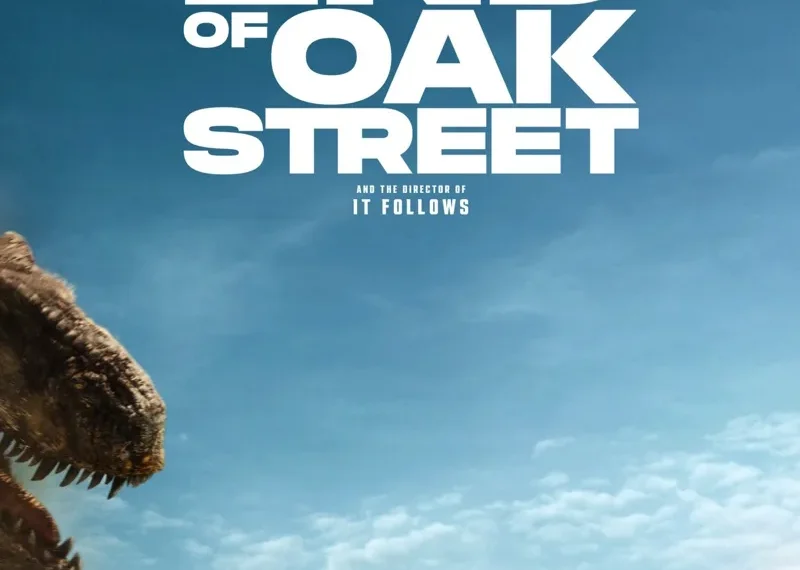
Cast: Anne Hathaway, Ewan McGregor, Maisy Stella, Christian Convery
Genre: Action, Adventure, Mystery, Sci-Fi, Thriller
Director: David Robert Mitchell
In Irish Cinemas: Now
David Robert Mitchell’s The End of Oak Street takes an outrageous science-fiction premise and approaches it from an unexpectedly human direction. The idea alone sounds like the setup for a giant creature feature: an ordinary suburban community in 1982 is suddenly displaced millions of years into the prehistoric world. Dinosaurs and other ancient dangers now surround homes, streets, and families that were never supposed to exist in such an environment. But Mitchell is less interested in making the movie a nonstop parade of prehistoric monsters than in examining what happens to ordinary people when the world they understand disappears overnight.
At its core, the film is a family drama disguised as a survival thriller. Denise and Greg Platt are already struggling with the state of their marriage when the impossible occurs. Their relationship has accumulated disappointment, financial pressure, and emotional distance, leaving them with problems that cannot simply be ignored once their neighborhood becomes a prehistoric wilderness. The catastrophe therefore becomes more than an external threat. It forces them to reconsider their priorities and confront issues they had previously been able to avoid.
Mitchell is particularly effective during the film’s early stages. Instead of immediately revealing the cause of the strange events, he allows the audience to experience them through small disturbances. Odd discoveries, unexplained changes in the environment, and unsettling clues gradually accumulate until the familiar suburban setting no longer feels trustworthy. This slow build gives the movie a mysterious quality and creates the impression that reality is quietly coming apart before anyone fully understands why.
The decision to place the story in 1982 adds considerably to its identity. The period setting feels integrated into the story rather than added merely for nostalgia. Oak Street initially represents a recognizable world of houses, jobs, family disagreements, and everyday responsibilities. Denise is attempting to establish herself as a novelist while questioning where her marriage is headed. Greg is dealing with professional failure and secretly working as a pizza delivery driver. Their children, Audrey and Brian, are navigating the usual complications of adolescence and childhood.
Those mundane details become increasingly important once the impossible arrives. The movie understands that the more ordinary the characters’ lives feel beforehand, the more disturbing their displacement becomes. A quiet residential street is supposed to be one of the safest environments imaginable. After the transition, however, every familiar location becomes potentially dangerous. Backyards, garages, vehicles, and houses no longer provide the security they once did.
Anne Hathaway gives Denise the kind of performance that keeps the film emotionally grounded. She does not portray Denise as an invincible survivalist who suddenly knows how to handle every crisis. Instead, she remains intelligent and frightened, making decisions while dealing with the emotional exhaustion that has already been weighing on her. Hathaway gives particular strength to the character’s quieter moments, allowing Denise’s dissatisfaction and fear to coexist with her determination to keep her family alive.
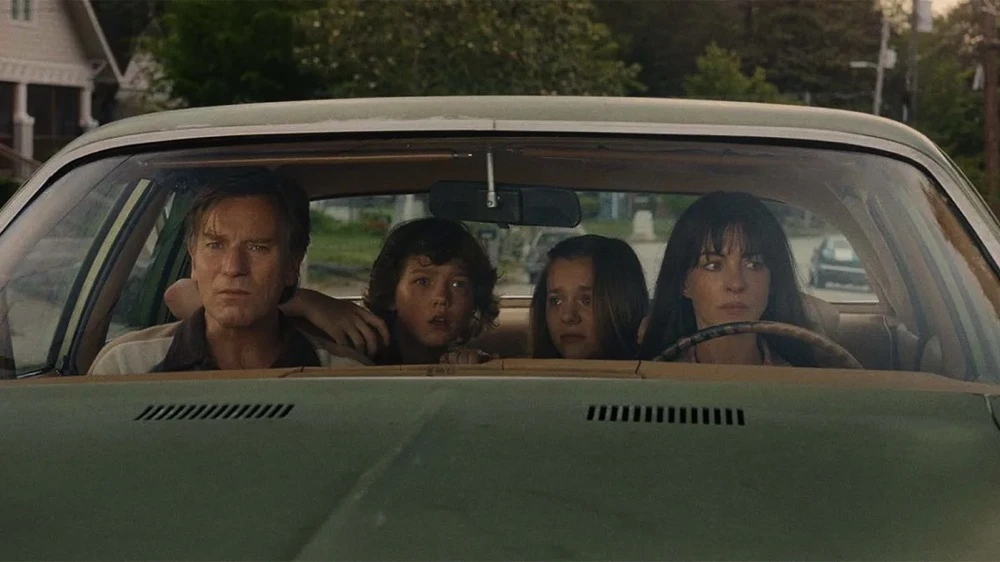
Ewan McGregor approaches Greg from a similarly vulnerable angle. His performance avoids turning him into either a conventional hero or an incompetent husband. Greg is caring but insecure, and his personal failures have contributed to the strain between him and Denise. That makes his relationship with her important even when the film is dealing with much larger dangers. The prehistoric crisis does not erase their marital problems; if anything, it makes them impossible to ignore.
The supporting cast helps expand the emotional scope of the story. Maisy Stella gives Audrey a believable mixture of teenage confidence and uncertainty, while Christian Convery brings warmth and vulnerability to Brian. Their sibling relationship feels lived-in, which makes the family’s predicament more affecting. Jordan Alexa Davis also adds depth as Jeannette, a character whose own experiences prevent her from becoming merely an additional person caught in the crisis. Her presence reinforces the film’s larger argument that survival is ultimately dependent on people learning to trust and help one another.
One of Mitchell’s smartest choices is refusing to explain everything too quickly. The strange phenomena surrounding Oak Street initially appear unrelated. Evidence of prehistoric life, unusual environmental changes, and other unexplained occurrences gradually form a larger pattern. By the time the possibility of a wormhole or some other scientific anomaly becomes relevant, the audience has already been immersed in the mystery.
The film does not appear especially interested in providing an exhaustive scientific explanation. That may disappoint viewers who want every detail of the phenomenon carefully established, but it suits Mitchell’s priorities. The science is primarily a mechanism for placing the characters in an impossible situation. The real question is not exactly how the neighborhood crossed millions of years of history, but what happens to its residents once they realize they are trapped in a world where humanity has no natural place.
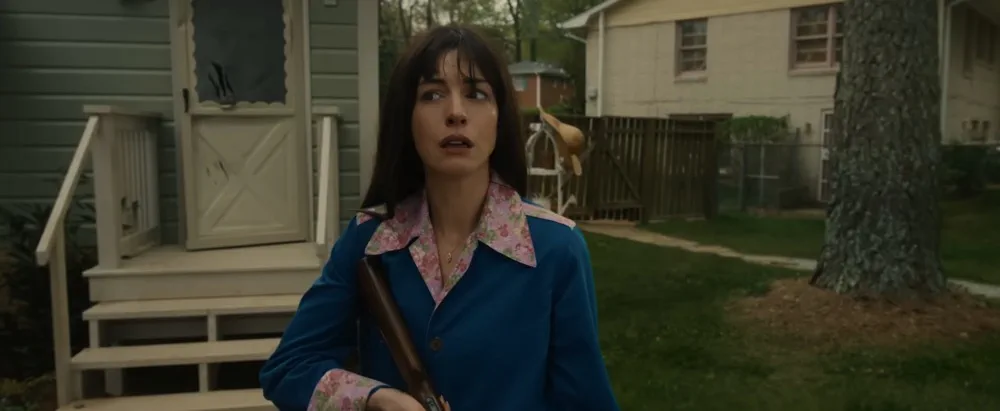
That change in environment is where the film’s creature elements become most effective. The dinosaurs are frightening because they are presented as genuine animals rather than conventional movie villains. They do not exist simply to attack the protagonists on schedule. They belong to the ecosystem, and the human characters are the intruders. That reversal gives the prehistoric setting a constant sense of danger.
Mitchell also shows considerable restraint with the creatures. Instead of filling every scene with digital spectacle, he often allows sound, scale, glimpses, and environmental details to create tension. A distant movement can be more unnerving than a full reveal. The audience is encouraged to imagine what might be beyond the frame, which preserves a sense of unpredictability.
Visually, the contrast between suburbia and prehistory provides the movie with some of its most memorable imagery. Neat lawns and residential houses suddenly sit within an ancient ecosystem. Familiar architecture becomes surrounded by landscapes that existed long before humans appeared. The collision between those two worlds gives the film a distinctive visual language and reinforces the idea that the characters have been completely removed from their natural context.
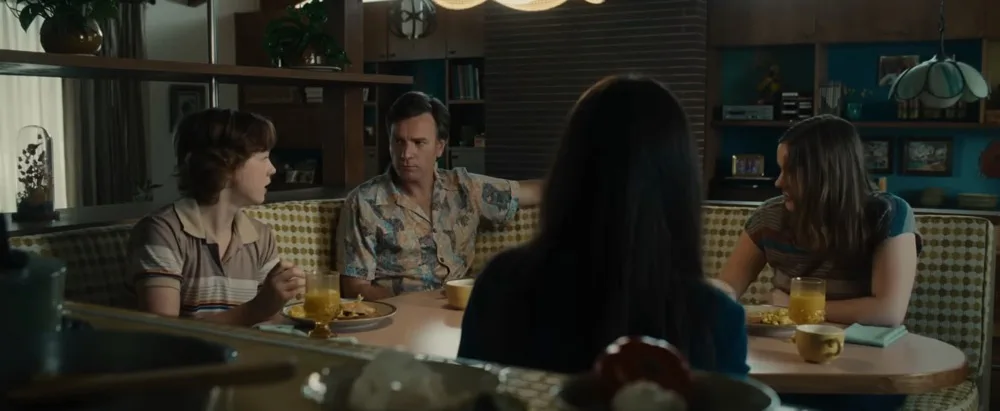
The atmosphere is arguably one of Mitchell’s greatest strengths. Even when the characters are not actively being pursued, there is often an underlying feeling that something is wrong. Strange light, environmental disturbances, unfamiliar sounds, and evidence of prehistoric life create a persistent sense of instability. The movie frequently feels less like a traditional action film and more like a nightmare that happens to contain dinosaurs.
That measured approach does have drawbacks. The film occasionally becomes too patient for its own good. Some sections of the middle act feel as though they are delaying developments that the audience is already anticipating. The mystery benefits from ambiguity, but there are moments when additional momentum would have helped.
There is also an unevenness in the treatment of the wider community. Denise, Greg, and their children receive substantial attention, while some of the other residents remain comparatively underdeveloped. Considering the premise, there is considerable potential in exploring how different personalities would respond to such an extraordinary disaster. Some people might panic, others might attempt to impose order, while others might become obsessed with finding an explanation. The movie only occasionally takes advantage of that possibility.
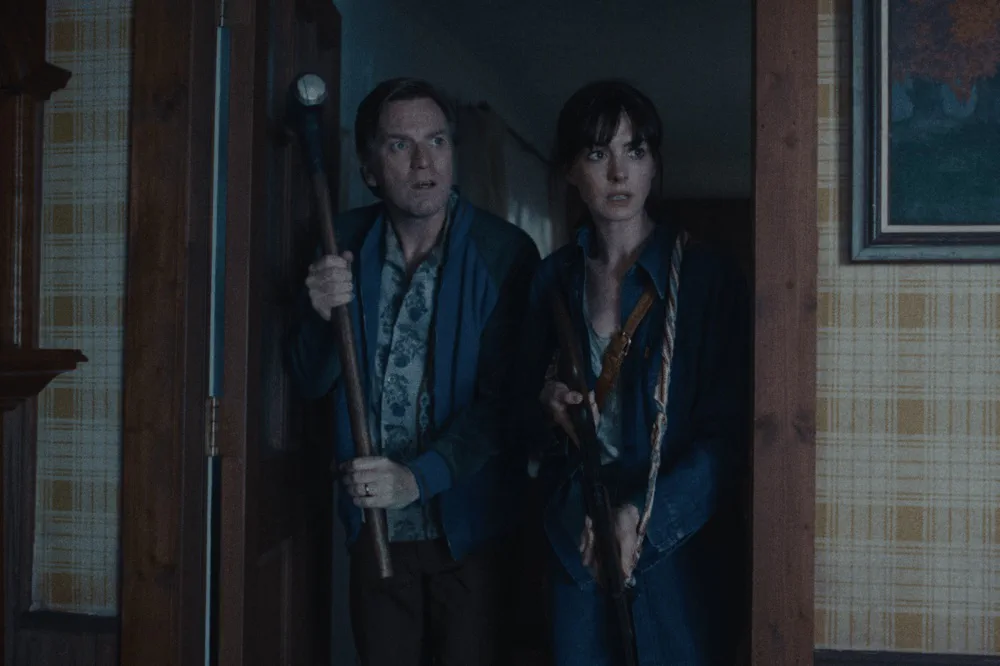
The deliberately vague science-fiction mythology presents a similar trade-off. Leaving certain questions unanswered strengthens the atmosphere and keeps the focus on the characters, but audiences who enjoy detailed world-building may wish the film provided a clearer account of what happened and whether there is any realistic path back to normality.
Even so, the weaknesses do not erase what makes the film distinctive. The prehistoric setting is ultimately a backdrop for a story about people whose old lives have become impossible to recover. Denise and Greg cannot continue pretending their marriage problems will resolve themselves. Their children are forced to mature rapidly. The other residents must abandon the routines and assumptions that once made their lives feel predictable.
That gives the film a thematic dimension beyond simple survival. Being transported millions of years into the past is an extreme version of something the characters are already experiencing emotionally: they have become disconnected from the lives they once knew. The strange new landscape reflects that sense of alienation. Nothing looks right, nothing behaves as expected, and the characters must determine what remains valuable when their previous definition of normal has disappeared.
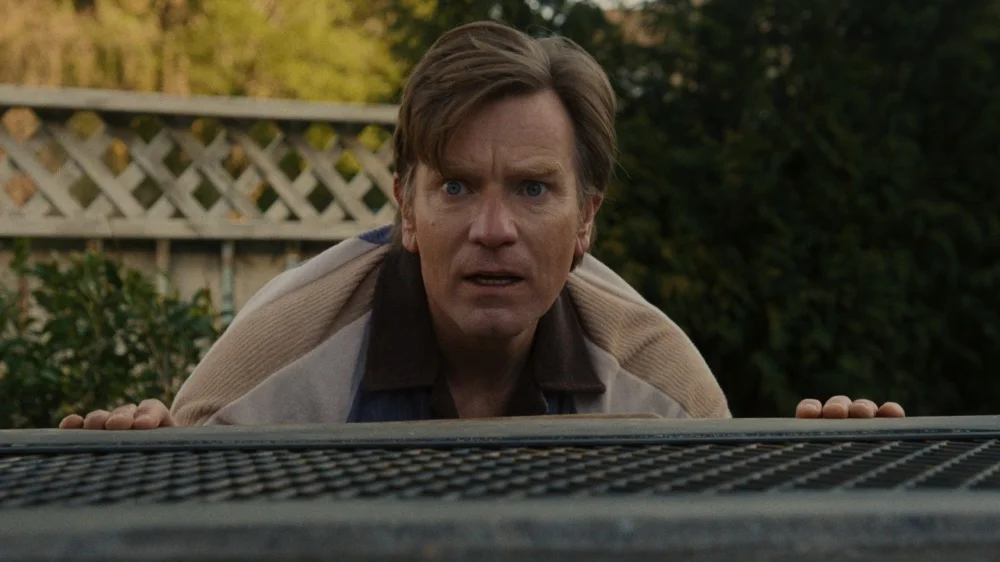
Importantly, Mitchell does not allow the movie to become entirely bleak. The danger creates opportunities for generosity, cooperation, sacrifice, and reconciliation. Characters who might previously have remained strangers are forced to depend on each other. The survival element therefore becomes inseparable from the emotional story. Staying alive matters, but so does deciding who is worth protecting and what kind of people they want to become.
The End of Oak Street ultimately succeeds because it treats its enormous premise as a means rather than an end. The dinosaurs and science-fiction mystery provide scale and danger, but the movie’s emotional center remains the Platt family and the fragile relationships surrounding them. Hathaway and McGregor give the central marriage enough complexity to make its problems meaningful, while the younger performers add authenticity to the family dynamic.
The film is not without imperfections. Its slow pace can occasionally test the viewer’s patience, several supporting characters deserved more attention, and its approach to the science-fiction explanation leaves plenty of unanswered questions. Nevertheless, those shortcomings are outweighed by its atmosphere, visual imagination, performances, and willingness to give a familiar survival premise an emotional foundation.
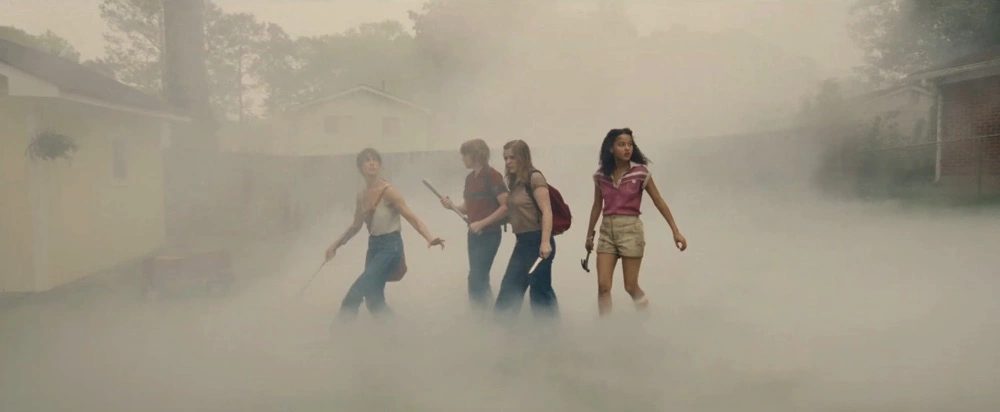
Rather than being solely a story about suburban families fighting dinosaurs, The End of Oak Street is about what happens when certainty disappears. Remove the familiar streets, jobs, routines, and expectations, and people are forced to confront both the world around them and the relationships they have taken for granted. Mitchell uses an extraordinary journey into the distant past to tell a surprisingly intimate story about fear, family, responsibility, and the possibility of starting over.
It may not provide a completely satisfying answer to every question raised by its premise, but that is not necessarily its greatest concern. What matters is the transformation of the characters. By placing ordinary people in an environment where almost everything is unfamiliar, Mitchell creates a survival film that is as interested in emotional endurance as physical survival. The result is an atmospheric and ambitious piece of science fiction that leaves a stronger impression because, beneath the prehistoric spectacle, it is ultimately about people trying to find their way back to one another.
Overall: 6/10

Movie Reviewer