
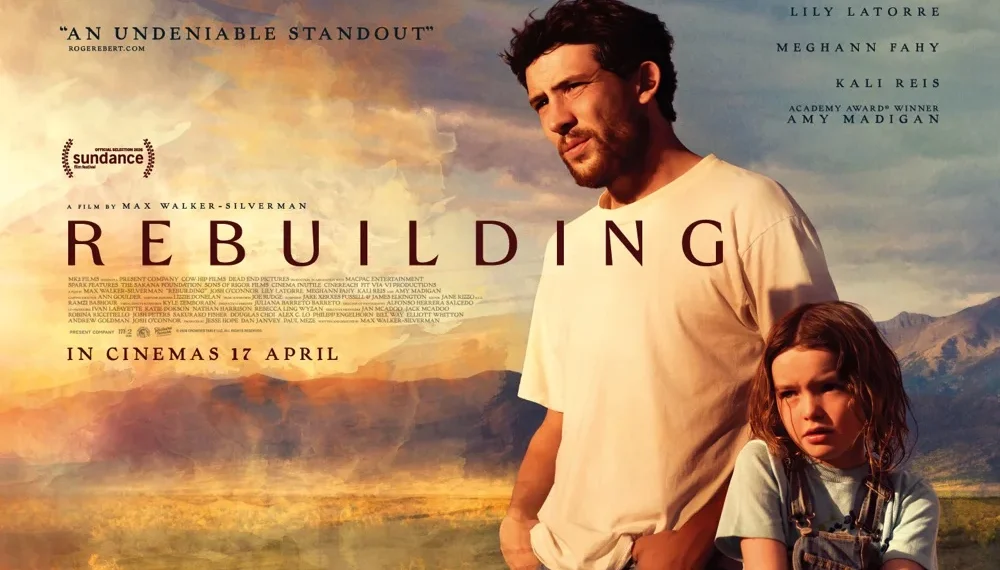
Reviewed on 28th January at the 2025 Sundance Film Festival
Cast: Josh O’Connor, Lily LaTorre, Meghann Fahy, Amy Madigan, Kali Reis
Genre: Drama
Director: Max Walker-Silverman
In Irish Cinemas: 17th April 2026
Displaced from his land and stripped of the life he once knew, a rancher is forced into the limbo of a trailer park, where recovery unfolds slowly in a drama marked by restraint and quiet compassion. Directed by Max Walker-Silverman, the film adopts the melancholic tone of a folk ballad, unhurried, observant, and emotionally understated. Josh O’Connor takes on the role of Dusty, a Colorado rancher whose world has been upended by wildfire. Generations of history vanish in the blaze, leaving behind land that, while still technically his, has been reduced to a lifeless stretch of ash and ruin. The opening images linger on this devastation: blackened tree lines and a horizon drained of vitality, establishing a sense of loss that extends far beyond property. Any hope of immediate recovery is quickly extinguished when a bank refuses financial support, deeming the land unusable for years to come.
With options exhausted, relocation becomes unavoidable. Dusty, like many others caught in similar circumstances, is pushed into a stark government-supported trailer site, temporary in design, yet indefinite in feeling. The adjustment is jarring. A man once rooted in routine and independence now navigates the indignity of unstable work, taking on a physically demanding and dispiriting job along the highway to stay afloat.
Personal relationships begin to shift under the weight of this upheaval. The bond with former partner Ruby (Meghann Fahy) gains new emotional texture, shaped by shared concern rather than past grievances. Their young daughter, Callie-Rose (Lily LaTorre), becomes a fragile bridge between past and present, her visits tinged with the awkward reality of her father’s new circumstances. Even small routines, like parking outside a library to access Wi-Fi so she can complete schoolwork, carry an undercurrent of quiet hardship. Meanwhile, Bess (Amy Madigan), Ruby’s ailing mother, offers a steady presence of warmth and empathy, grounding the story in intergenerational care.
Though Dusty clings to the idea of rebuilding, the path forward remains uncertain. A potential job opportunity with family in Montana represents escape as much as it does compromise. Yet, amid the instability, a different kind of reconstruction begins to take shape, one rooted not in land or ownership, but in connection. Within the trailer community, a fragile solidarity emerges. Among its residents is Mali (Kali Reis), whose resilience and guarded warmth hint at something deeper than companionship.
Moments shared around campfires, fleeting conversations, and the quiet rituals of survival lend the film a texture reminiscent of Nomadland, where transient lives are rendered with dignity and care. Yet, despite the story’s grounding in environmental catastrophe, broader conversations remain conspicuously absent. The escalating reality of climate-driven disasters is left unspoken, treated as an accepted, almost cyclical misfortune rather than a growing crisis. Institutional response appears limited to short-term relief, offering shelter without long-term solutions.
The narrative also echoes elements of Wildlife, adapted from Richard Ford’s work, particularly in its portrayal of fire as both a literal and emotional force. However, where that story leans into fracture, this one leans toward quiet endurance.
At its core lies a performance from O’Connor that trades on subtlety. The reserve often associated with his earlier roles is reshaped here into something sturdier yet deeply exposed, a portrayal of a man carrying loss without spectacle, defined as much by what remains unspoken as by what is shown.
Overall: 7/10

Movie Reviewer