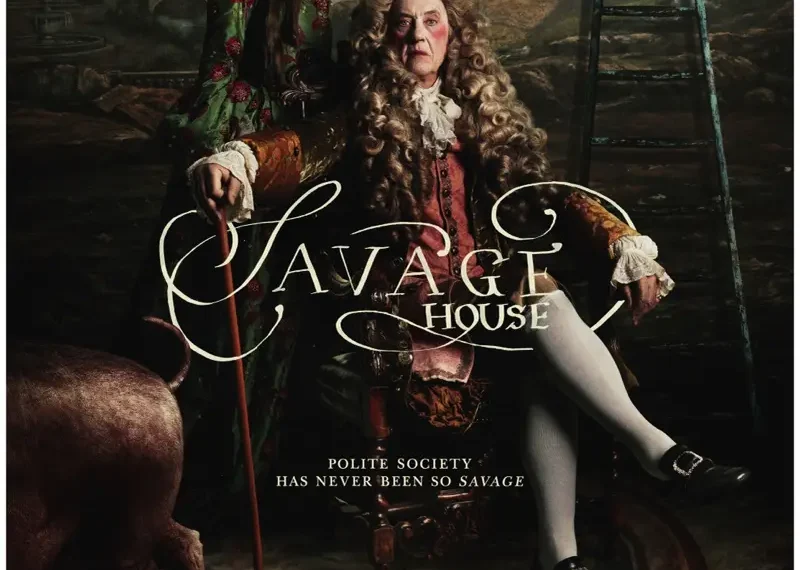
Cast: Richard E. Grant, Claire Foy, Jack Fathing, Bel Powley, Kíla Lord Cassidy
Genre: Comedy, Drama
Director: Peter Glanz
In Irish Cinemas: 5th June 2026
Period dramas have spent much of the last decade shedding their reputation for restraint. Rather than embracing the genteel manners and polished decorum traditionally associated with the genre, many recent productions have injected historical settings with irreverence, excess, and scandal. Television hits such as Bridgerton and The Great revel in modern attitudes and sexual frankness, while Yorgos Lanthimos’s acclaimed film The Favourite transformed royal intrigue into something sharp, chaotic, and darkly comic worlds away from the comforting rhythms of Downton Abbey.
Peter Glanz’s Savage House comfortably belongs to this newer wave of historical storytelling. Set in the 18th century, the film approaches its period backdrop with cynicism and mischief rather than nostalgia. Its portrait of an opportunistic aristocrat clawing for social advancement recalls elements of Barry Lyndon, while its willingness to mock the pretensions of the upper classes occasionally evokes the offbeat sensibilities of The Draughtsman’s Contract. Even so, Glanz’s film remains far more accessible and straightforward than either of those inspirations.
At the centre of the story is Lord Chauncey Savage, played with relish by Richard E. Grant. Chauncey is a man whose ambition greatly exceeds both his means and his judgment. Having married Lady Savage, portrayed by Claire Foy, largely for the prestige and wealth attached to her family name, he has since squandered much of that fortune through reckless extravagance, leaving the couple drowning in debt.
Their home reflects their decline. Although technically a grand estate, it is now a decaying shell of its former self, marked by neglect and rot. Glanz repeatedly draws attention to the property’s less glamorous details spoiled food, crumbling interiors, and general squalor creating an atmosphere that feels worlds apart from the grandeur Chauncey desperately wants to project. Yet despite its condition, the estate still offers refuge from the political unrest and disease spreading beyond its gates.
A stroke of fortune arrives when a devastating outbreak forces another noble household to cancel a planned dinner for the influential Duke and Duchess of Devonshire. Suddenly, the Savages find themselves with a rare opportunity: host the prestigious guests instead and perhaps restore some of their lost standing. Sensing a chance to reinvent their fortunes, Chauncey and his wife throw themselves into preparations, financing a frantic makeover by selling off the last valuable pieces of family inheritance and demanding extraordinary efforts from their long-suffering staff.
Predictably, nothing proceeds smoothly. Chauncey’s health rapidly deteriorates when what appears to be a minor injury develops into a severe case of gout. Members of the household are engaged in secret affairs and private schemes, while disgruntled victims of Chauncey’s questionable business dealings repeatedly appear seeking answers and repayment. With every new complication, the possibility of disaster grows.
The resulting film functions primarily as a farce, and much of its success rests on Grant’s performance. He throws himself into Chauncey’s increasingly desperate antics, delivering the character’s tantrums, delusions, and outbursts with infectious enthusiasm. Foy provides a strong counterbalance, grounding the madness with a more measured presence that highlights the absurdity surrounding them.
Glanz keeps the narrative moving at a brisk pace and peppers the screenplay with a steady stream of witty observations. While the humour is often amusing, it rarely escalates into outright hilarity. One recurring weakness is the film’s dependence on narration, which often conveys information that could have been communicated more effectively through action or visual storytelling.
Where Savage House truly comes alive is in its embrace of the grotesque. The film’s most memorable moments emerge when it abandons polite satire and ventures into stranger territory, whether through Chauncey’s gradual psychological unravelling or the unsettlingly graphic depiction of physical decay and illness. These darker, more unsettling elements hint at a bolder and more distinctive film lurking beneath the surface.
As it stands, Savage House never fully commits to those more daring instincts. Nevertheless, it remains an enjoyable and energetic comedy, elevated considerably by two committed lead performances and a willingness to get its hands dirty in ways many costume dramas would never dare.
Overall: 6.5/10

Movie Reviewer