

Cast: Steve Harris, Bruce Dickinson, Nicko McBrain, Adrian Smith, Dave Murray, Janick Gers
Genre: Documentary, Music
Director: Malcolm Venville
In Irish Cinemas: 7th May 2026
Attempting to distil five decades of a band’s history into under two hours might seem like an impossible task. Iron Maiden: Burning Ambition approaches that challenge from an unexpected angle by shifting much of the narrative weight away from the band itself and onto the vast, fiercely loyal global following that has sustained it.
For a group as monumental as Iron Maiden, the relationship with fans has always been central. That dynamic becomes the backbone of this 106-minute documentary, directed by Malcolm Venville. Rather than functioning as a straightforward chronological retelling, the film frames the band’s evolution through the voices, experiences, and emotional investments of those who have championed them across generations.
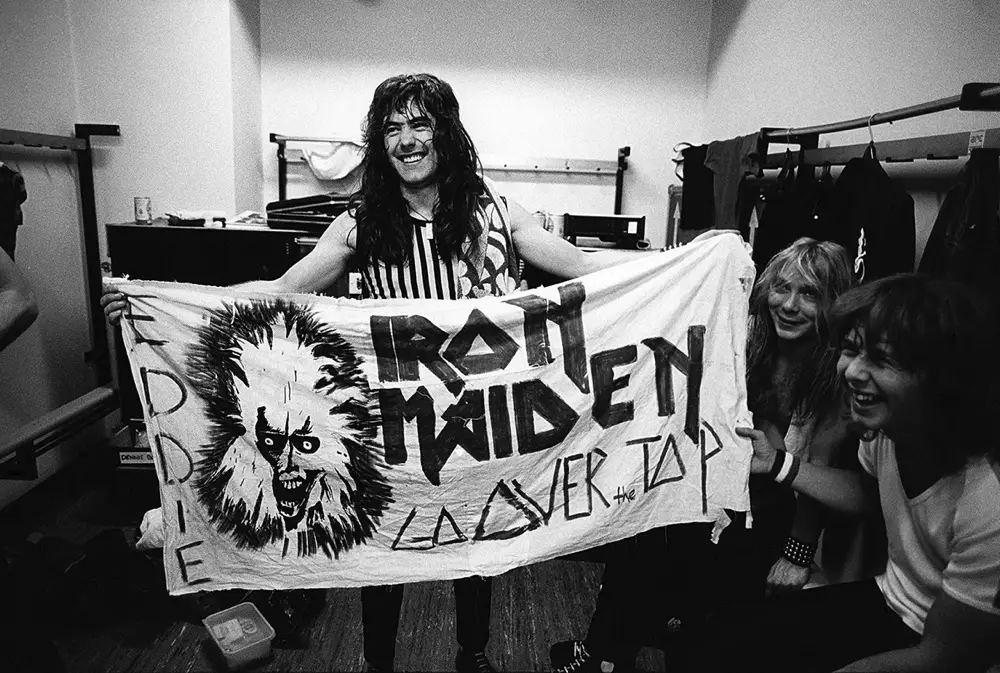
That is not to suggest the band’s internal history is overlooked. The film carefully traces the shifting lineup eras, supported by a treasure trove of archival material, rare photographs, performance footage, and candid moments that grow increasingly striking the further back the timeline reaches. These glimpses into the past capture a young Steve Harris and the early, ever-changing roster as they set out with little certainty but immense determination, laying the groundwork for what would become a global phenomenon.
Interestingly, while the band members contribute narration and reflections, their present-day appearances are absent. Their voices guide the story, offering candid insights and personal admissions, while the visuals remain rooted in the past. This stylistic choice subtly redirects attention away from individual personalities and toward the broader cultural force the band has become, as well as its unmistakable iconography, including its skeletal mascot, Eddie.
At the heart of the film lies a diverse cross-section of admirers. These range from globally recognised musicians such as Gene Simmons, Lars Ulrich, Tom Morello, Scott Ian, Chuck D, Simon Gallup, and Katon De Pena, to actors Javier Bardem and others, alongside professionals and everyday devotees. Even among these high-profile figures, on-screen captions deliberately identify them first and foremost as fans, reinforcing the film’s core message.
The spectrum of voices highlights a unifying idea: admiration for the band transcends geography, profession, and background. Concert footage featuring Bruce Dickinson addressing audiences underscores this inclusivity, emphasising that belonging to this community requires nothing more than a shared passion for the music.

A recurring theme emerges: what defines a band without its audience, and how far can unwavering support propel a group that largely bypassed mainstream radio exposure? The film positions Iron Maiden as a compelling case study, charting how dedication on both sides forged a lasting legacy.
For long-time followers, much of the historical detail may feel familiar, given the abundance of existing material chronicling the band’s journey. Yet the documentary distinguishes itself through perspective rather than revelation. The familiar arc formation, ascent, setbacks, and resurgence remain intact, but the emphasis lies in how those phases were experienced collectively.

Moments of ambition and uncertainty receive equal attention. Early years marked by relentless lineup changes convey a restless pursuit of the ideal configuration, while peak achievements, such as the gruelling World Slavery Tour and Landmark performances at Rock in Rio, illustrate the scale of eventual success. Innovations such as Dickinson piloting the band’s aircraft further demonstrate a commitment to connecting with audiences worldwide.
The narrative does not shy away from internal struggles. Adrian Smith’s battle with depression amid rising success reveals the personal cost of relentless ambition. The tenure of Blaze Bayley is reassessed with nuance, distributing responsibility for that era’s challenges more evenly. Meanwhile, tensions surrounding Dickinson’s departure in the 1990s are revisited through the candid perspective of Nicko McBrain, whose criticism centres on perceived disregard for the fanbase, a concern that once again circles back to the film’s central theme.

Even the eventual reunion, which ushered in a prolonged and highly successful era, is framed through reconciliation and shared purpose, demonstrating how past conflicts gave way to renewed momentum.
Ultimately, the documentary resonates beyond its immediate subject. Those deeply familiar with Iron Maiden will recognise much of the terrain. Still, the film’s strength lies in its reframing: presenting a globally influential band not just as performers but as the nucleus of a far-reaching cultural community. For casual observers, it offers an accessible entry point into a story that challenges assumptions about heavy metal and its audience.

Rather than attempting to serve as a definitive chronicle, Iron Maiden: Burning Ambition functions as a complementary piece within a much larger narrative. Its focus on the reciprocal bond between artist and audience captures an essential truth: the scale of Iron Maiden’s legacy cannot be understood without acknowledging the millions who helped build it.
Overall: 7/10

Movie Reviewer