
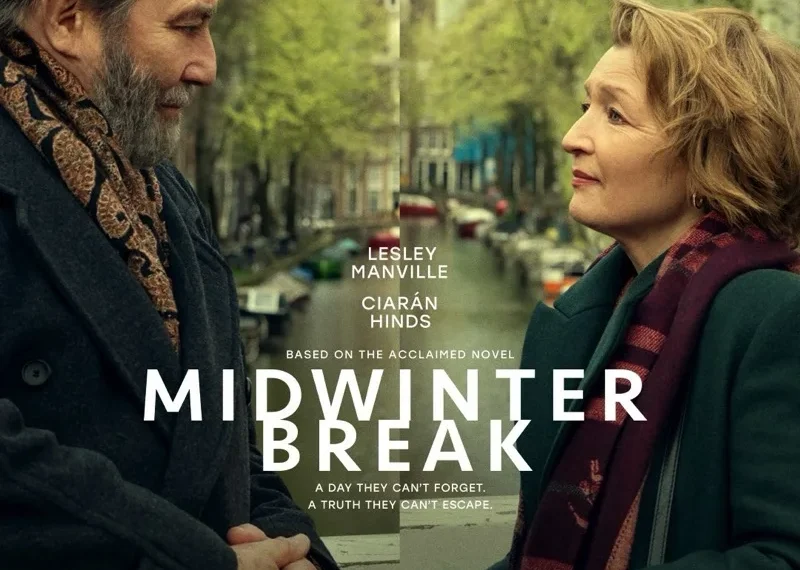
Cast: Lesley Manville, Julie Lamberton, Ciarán Hinds, Ed Sayer, Niamh Cusack, Leila Laaraj
Genre: Drama
Director: Polly Findlay
In Irish Cinemas: Now
A quietly powerful film at risk of being overlooked, Midwinter Break stands as a deeply affecting adult drama anchored by the remarkable presence of Lesley Manville and Ciarán Hinds. While the pairing alone is enough to draw attention, Polly Findlay’s striking feature debut offers far more than star appeal. What unfolds is an emotionally rich and contemplative work that lingers long after its final moments.
At first glance, the film presents itself as a gentle relationship drama, unassuming in tone and structure. Yet it quickly becomes clear that Polly Findlay is pursuing something far more layered. Following a married couple, Stella and Gerry, during a holiday in Amsterdam, the narrative gradually reveals a tapestry of unspoken tensions and deeply rooted emotional truths. Beneath the surface of their affectionate dynamic lies a history marked by personal struggles and long-suppressed pain, which the film carefully and patiently brings into focus.
Adapted from Midwinter Break, the story resonates with particular poignancy for those familiar with the rhythms of long-term relationships. It examines how past trauma can quietly shape the course of a life while also exploring the intricate balance required to sustain intimacy over time. There is both warmth and fragility in the portrayal of enduring love, alongside a clear-eyed understanding of how essential honest communication becomes as years pass.
Stella and Gerry share decades of history, their early years overshadowed by a harrowing experience during The Troubles. Though they managed to build a life beyond it, relocating from Belfast to Glasgow, raising a son, and establishing stable careers, the emotional residue of that period has never fully dissipated. Now, with their son grown and living independently, they find themselves confronting the quieter, more introspective phase of life together.
As the story unfolds, subtle fissures begin to appear. Stella’s deep religious faith contrasts sharply with Gerry’s scepticism, often surfacing in moments of gentle but telling friction. Meanwhile, Gerry’s relationship with alcohol hints at a deeper unease he is reluctant to acknowledge. In an attempt to rekindle something within their marriage, Stella arranges a trip to Amsterdam, a gesture that initially carries a sense of renewal and possibility.
However, the change of scenery cannot mask what lies beneath. The emotional turning point arrives when Stella begins to articulate feelings long left unspoken, shifting the film into a more revealing and introspective second half. From this moment on, the narrative deepens, peeling back layers of both characters and reframing their connection. Manville and Hinds bring extraordinary subtlety to these shifts, delivering performances that feel wholly authentic and deeply lived-in.
Findlay’s direction embraces a deliberate, unhurried pace that allows each moment to breathe. What may initially seem like quiet or ordinary scenes gradually accumulate meaning, each one contributing to a fuller understanding of the couple’s shared life. Small gestures, passing remarks, and fleeting expressions all carry weight, building a nuanced portrait of a marriage shaped as much by silence as by spoken words.
One devastating line encapsulates the film’s emotional core: a quiet admission that calls into question not just the state of a marriage, but the very foundation it rests upon. That sense of honesty defines the entire piece. Midwinter Break does not shy away from difficult truths; instead, it confronts them with sensitivity and restraint. The result is an intimate, emotionally intricate drama that speaks directly to an audience too often underserved, one seeking depth, maturity, and genuine human insight.
In every sense, it emerges as a standout work: thoughtful, resonant, and quietly unforgettable.
Overall: 6/10

Movie Reviewer