Cast: Ethan Hawke, Russell Crowe, Julia Jones, Austin Amelio, Avi Nash and Sam Hazeldine
Genre: Action, Adventure, Crime, Drama, Thriller
Director: Padraic McKinley
In Irish Cinemas: 2nd October 2026
Ethan Hawke has always been the kind of actor who seems capable of disappearing completely into a character, but there is something especially raw about what he brings to The Weight. Some have already called it the defining performance of his career. I’m not quite ready to go that far First Reformed remains, for me, an extraordinary piece of acting, but that hardly diminishes what Hawke accomplishes here. He is magnificent.
More importantly, The Weight gives him the kind of material that allows that talent to breathe.
Directed by Padraic McKinley, this bruising Depression-era thriller drops us into the unforgiving Oregon wilderness of the 1930s. The film was shot in Bavaria, but its landscape feels appropriately vast, hostile and isolated. It is a world where survival often comes down to endurance, muscle and the willingness to make morally questionable choices.
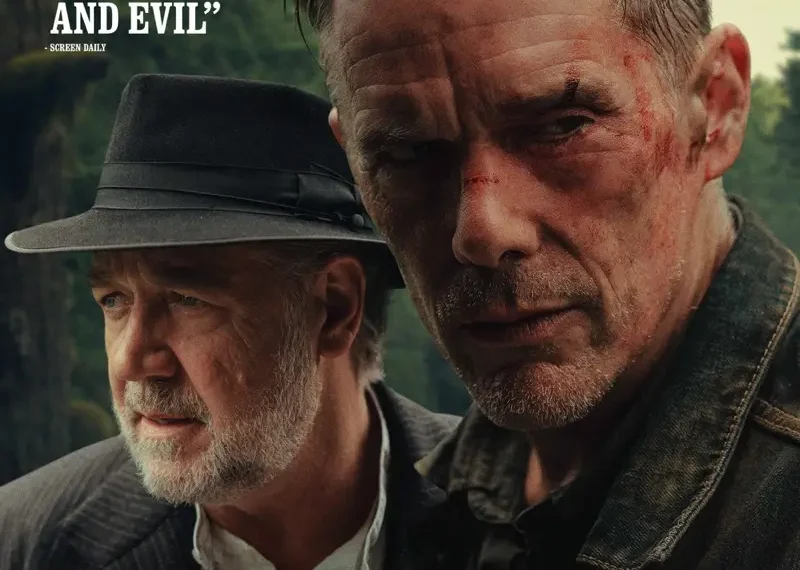
Hawke plays Samuel Murphy, a struggling father whose relationship with the law is considerably less complicated than his relationship with morality. Murphy is neither hero nor villain. He’s a man running out of options, propelled by equal parts desperation, pride and love for his daughter Penny, played with remarkable naturalism by Avy Berry. When Murphy’s determination to provide for her leads him into serious trouble, the consequences are swift and unforgiving. After striking a police officer, he finds himself imprisoned in a brutal work camp with no guarantee that he’ll ever make it home.
And waiting on the other side of those prison walls is Clancy, played by Russell Crowe.
Crowe gives the film another fascinating center of gravity. His warden carries the authority of his position, but beneath that power is a man dealing with his own particular form of desperation. The tension between these two men becomes one of the film’s greatest assets, with Hawke and Crowe creating a volatile dynamic that gives the story much of its dramatic force.
There is a distinctly old-school quality to The Weight. This is the kind of physical, hard-edged filmmaking that recalls the great survival and prison dramas of another era — movies such as The Treasure of the Sierra Madre and Cool Hand Luke. Yet the film doesn’t feel like a museum piece. McKinley brings enough urgency and visual confidence to make the familiar elements feel immediate.
The screenplay from Matthew Chapman and Shelby Gaines follows a recognizable path, but familiarity isn’t necessarily a weakness when the execution is this strong. The characters are compelling, the stakes remain tangible, and the supporting cast consistently finds ways to make an impression. Avi Nash, Lucas Lynggaard Tønnesen and Austin Amelio all leave their mark, with Amelio particularly memorable as Rankin.
Still, the film ultimately belongs to Hawke and Crowe.
Both actors understand that the men they’re playing don’t have the luxury of being vulnerable in obvious ways. Their masculinity is less about swagger than survival — something hardened by circumstance and defended at almost any cost. Hawke, in particular, finds the emotional fractures underneath Murphy’s bravado, allowing us to see the frightened father beneath the increasingly desperate exterior.
And then there’s Berry, who brings an unexpected warmth to the film. Penny could easily have become little more than a plot device, but Berry gives her enough personality and presence to make Murphy’s desperation feel personal rather than merely functional.
The technical work deserves attention as well. Shelby Gaines and Latham Gaines provide a score that gives the film an additional emotional pulse, while Matteo Cocco’s cinematography transforms the rugged setting into something simultaneously beautiful and threatening. Esther Walz’s costumes and Cora Pratz’s production design further establish the period without overwhelming the performances.
What makes The Weight particularly satisfying is that it never asks Hawke to carry the entire picture alone. The filmmaking, ensemble and atmosphere are strong enough to meet him where he is. That’s an important distinction because Hawke has delivered several performances in recent years that feel almost too good for the films surrounding them.
Here, the match feels right.
Whether this ultimately proves to be Hawke’s finest work is a debate worth having, but there is no question that he’s operating at an exceptionally high level. The Weight is a tough, muscular and beautifully performed thriller that deserves considerably more attention than it may initially receive. Hopefully its Vertical release gives it the opportunity to find the audience and the awards-season consideration that this remarkable performance warrants.
Overall: 7/10

Movie Reviewer