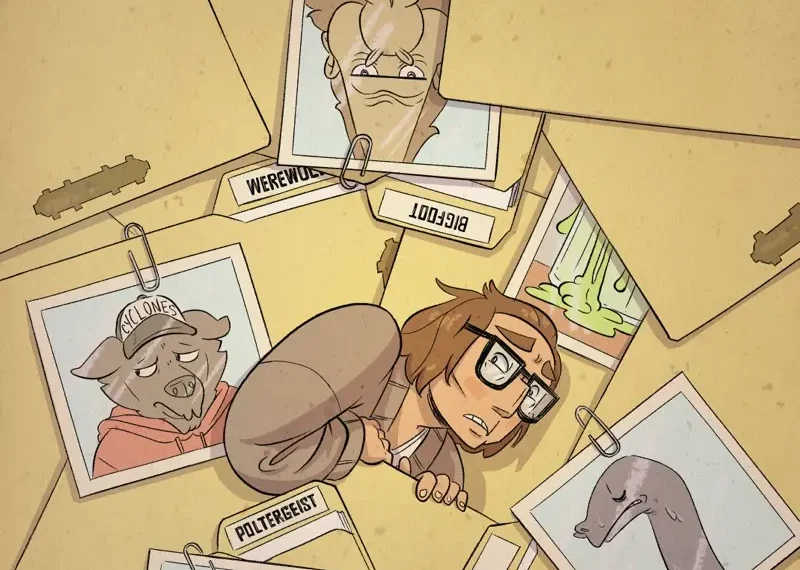
With the release of the Parapsychologist graphic novel from Comixology Originals tomorrow, we are delighted to be joined by Taki Soma and Mark Schey. Taki is a HUGO Award-nominated cartoonist. Taki has worked on numerous comics/graphic novels, including Alienated, United States of Murder, Inc., Bitch Planet, Dick Tracy, Iron Man and Sleeping While Standing. Mark Schey is a writer whose comics work includes editing Alienated and co-creating Black Box Chronicles and the reboot of Deadline UK.
Hi Taki and Mark, it’s so wonderful to have you both here with us. Could you introduce yourselves to our readers?
Taki Soma: Hi, thanks for having us! I am Taki Soma, most well known for illustrating an issue of Bitch Planet with Kelly Sue Deconnick that was nominated for HUGO awards, my auto-bio, Sleeping While Standing, Murder, Inc. with Brian Bendis and Michael Oeming, of course, another Comixology Original series, Alienated with John Broglia, and so many more. I consider myself a cartoonist since I may work on the art and writing, or both, depending on the project.
Mark Schey: Hey, thanks for talking with us. I’m newer to comics than Taki, having been a television commercial writer and director for many years. My first graphic novel was Black Box Chronicles from Magnetic Press, which is where I first worked with Taki. I also have a short in the new A1 Deadline revival called “Self-Aware in AISLE 5.”
Can you tell us about the origins of Parapsychologist?
TS: I have to say that it began the moment Mark Schey blurted out ‘Parapsychologist’ during our brainstorming session figuring out a different project we thought we were going to work on together. We looked at each other (over zoom) and we knew instantly that this is what we were meant to do. To mash together many genres we love, into one. Like you do.
MS: Yeah, apparently, in the middle of brainstorming, I blurted out “parapsychologist” and we both just knew. Taki and I co-wrote two stories in Black Box Chronicles. The book was massive, juggling about 13 stories and art teams. We had a mutual friend who sent me a copy of Taki’s Sleeping While Standing, which is, well, brilliant. I’m not sure I even got through half of it before I was like, “We need to get her voice in this book.” We became friends and thought it would be fun to do another project together.
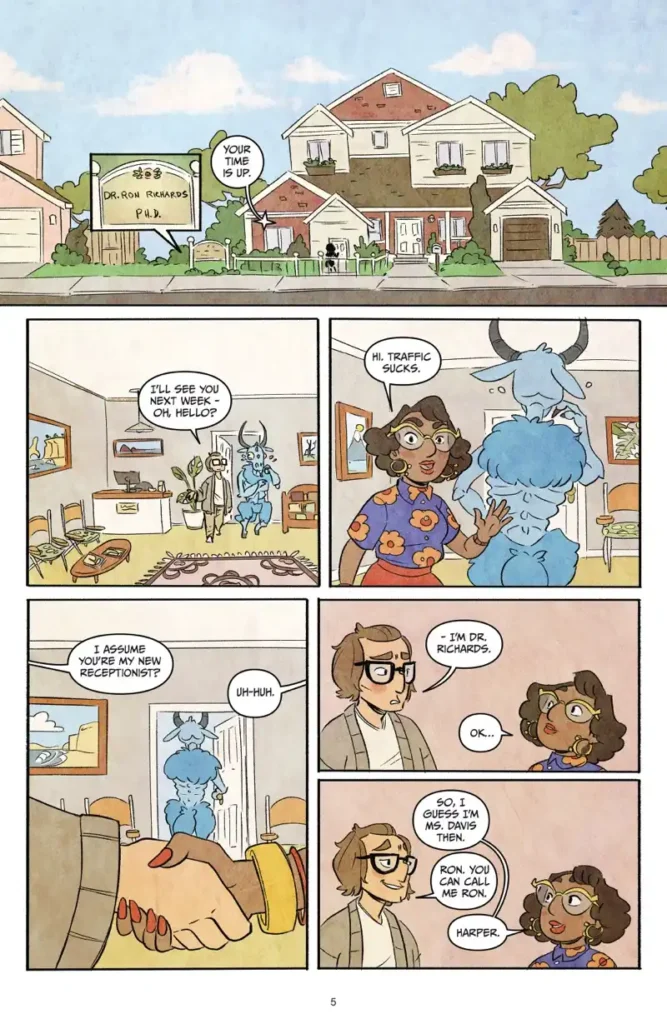
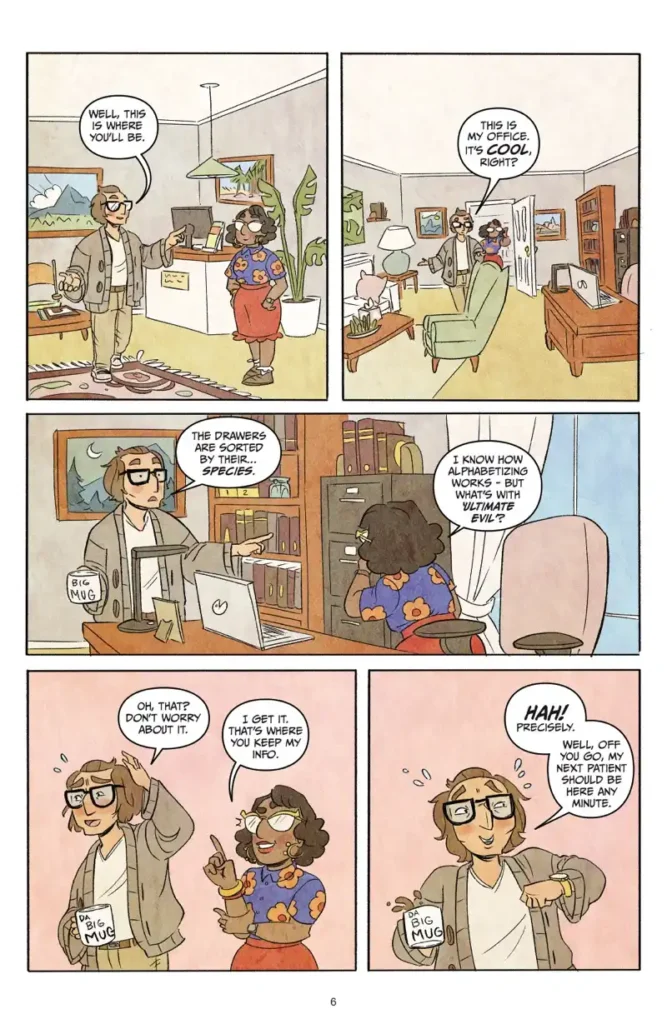
Who is Dr. Ron Richards?
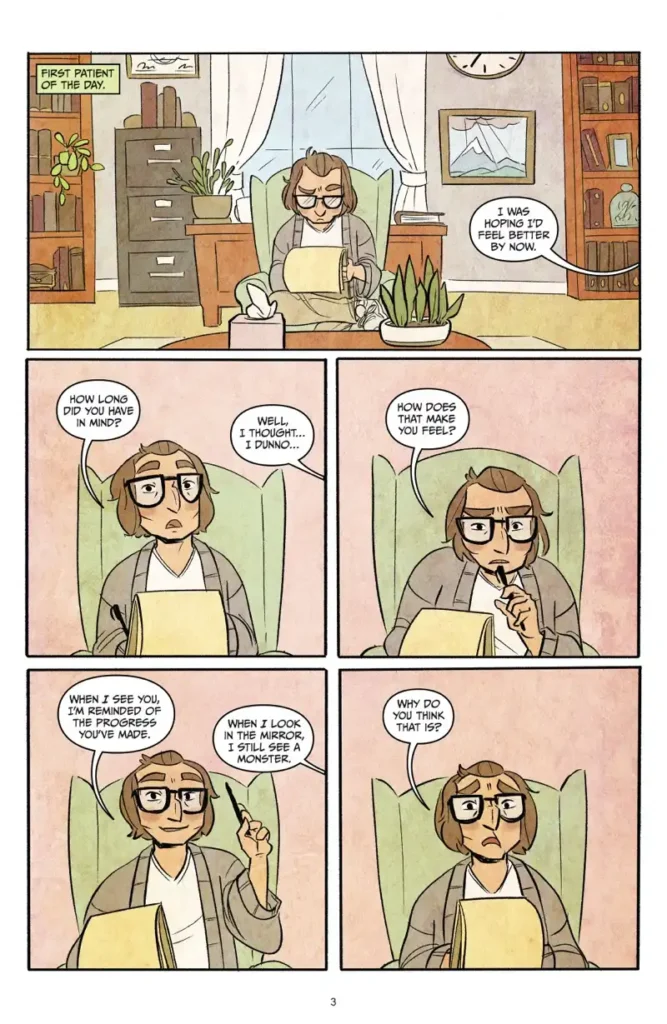
TS: He’s your psychotherapist. Did you not know that? Oh man, you’re probably going to see a bill from him soon. He’s also the reason for Parapsychologist, he helps people, except these people are paranormal, supernatural hee-bee-jee-vees (that’s the correct spelling in the paranormal world.)
MS: Dr. Richards is juggling his private parapsychology practice and family life. One minute he’s working with a cryptid, the next he’s worried about who his daughter is dating. He has a lot of my own personal struggles with balancing work while watching his kids grow up.
What made Cat Farris the right artist for Parapsychologist?
TS: I think when you see the cover and read the story, you’d understand why. She has a style that’s both comforting and clean. That’s what was needed for Parapsychologist to ground the monsters and ghouls so that they can be relatable. She’s perfect.
MS: When you’re putting together a project like this, casting the artist is one of the most important decisions you make. Cat is talented, cool, and knows the Pacific Northwest intimately. When you’re making a graphic novel, the art has to reflect the tone of the story. Cat captured that perfectly.
How did Chris Northrop and Mary E. Brickthrower join the team?
TS: We asked them! And they are really good at what they do. This project wouldn’t have come together like it did without them. I know them personally, as well as Mark, and we knew they would come through like the champs they are.
MS: Chris is my partner at Horrible Future. We met because he went to high school with my wife. She kept saying “You need to talk to him.” Eventually, I did. Chris is incredibly talented and meticulous in book design, writing, and lettering. And he did the coloring on Critical Role: Vox Machina. He’s someone you want on your side in the world of comics.
Mary is genuinely the reason we’re here today. I worked with her husband when I was directing commercials, and we discovered we were mutual friends with Mike and Taki. When I was working on Black Box Chronicles, I made her a 3D-printed mask from Phantom of Paradise, the cult classic by Brian De Palma. Oeming responded, and I was like, wait, you know him? Mary was like “Know him? We’re good friends.”
Can you tell us what it was like writing Parapsychologist together?
TS: It was challenging at times and other times I was really glad to have a partner to write with. I learned a lot from this experience too. I had the most fun just tossing around ideas and having deep discussions on the motivation behind a Werewolf, or the heroes’ journey of a poltergeist.
MS: We worked hard to set up this world and these characters. Once we worked that out, the characters took on a life of their own, and it got much easier, despite the outside world conspiring against it. Maybe the book was cursed. Possibly one of Dr. Ron’s patients?
How much of your own real-life experiences are seen in the office of Dr. Ron Richards?
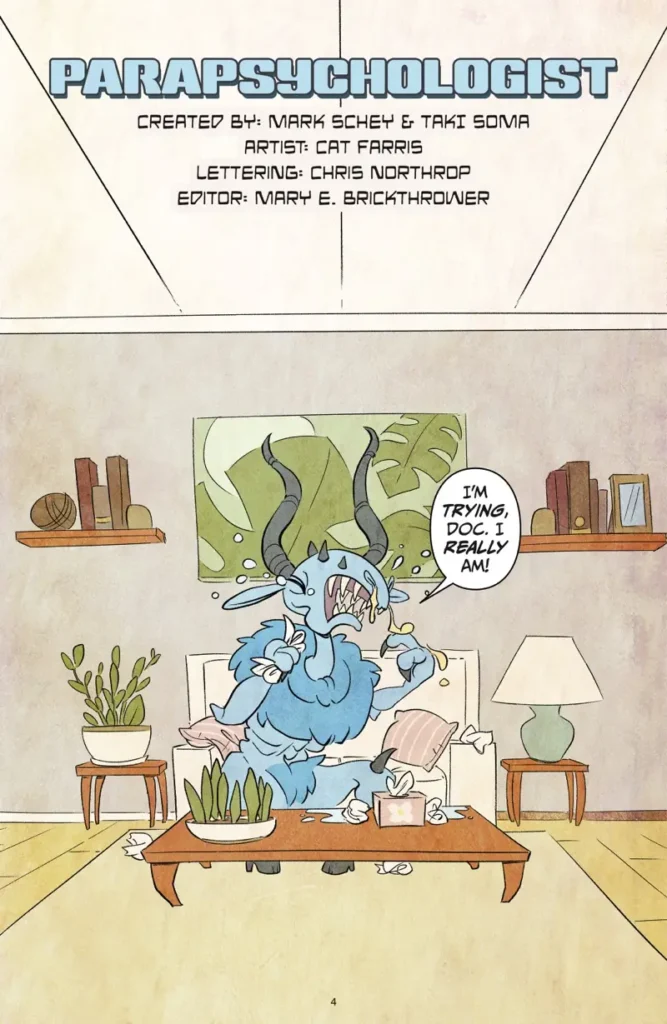
TS: Dr. Richards is a little bit of Mark’s therapist from the past, and little bit of one of mine. And the big mess that is the patients are metaphors of our own struggles or struggles of people close to us. So… a little bit?
MS: More than I’d probably admit. The family stuff especially. That feeling of being pulled in different directions, wanting to be great at what you do but also being there for your kids. Dr. Ron’s relationship with his kids is probably the most personal thread for me. And the therapy sessions themselves draw on real observation and experiences. I’m always cataloguing the weird, funny, deeply human things people do when they think no one’s paying attention. Or as Paul Thomas Anderson might say, “Quietly judging you.”
As writers, is it important to have a graphic novel dealing with real-life issues?
TS: I can only say this; that I deal with real-life issues by writing. By telling stories fictional or not. I think it’s important to express yourself if you are compelled. And I believe by creating through genuine intention, it will come through in the story.
MS: Whether you’re writing horror, sci-fi, or comedy, it’s ultimately the human connection that resonates with the reader. Those are certainly the most interesting stories to me, and I think it’s important to be authentic. It bugs me when I read or watch something where clearly the writer didn’t understand the thing they were writing about. Readers can tell.
What is it about Comixology Originals that made you want to publish Parapsychologist with them?
TS: They are the perfect way to get this out there. The moment it’s available, you can read it on a screen. No need to order the physical media, wait for it, or make a trip to the store. I love that it’s instant. It’s very ‘now’, don’t you think?
MS: Reach is a big part of it. Comixology gave us access to an enormous audience that most indie books never get in front of. When you’re building something you care about, you want it to actually find its people. For a creator-owned project, that’s a big deal.
Can you tell us about the world in which Parapsychologist is set?
MS: It’s pretty similar to ours, except paranormal creatures are accepted as a part of it. We don’t go into why, because it doesn’t matter to our story. That’s just the world Dr. Ron lives in. I think the best world-building is the stuff that doesn’t call attention to itself. It just is, and you accept it because the characters do.
TS: I don’t believe we say exactly, but it’s meant to take place in the Pacific Northwest. More precisely, Portland, Oregon. To be more accurate, it’s 1526½ Twelve-tenth Street Blvd. Portland, OR.
MS: That’s not canon.
Are the clientele of Dr. Ron Richards based on people you know?
TS: Yes, they are all in witness protection, so I cannot comment further.
MS: I plead the fifth.
Has writing Parapsychologist been a challenge?
TS: It was a challenge when I had some medical issues that went awry. I’m always sick, but it was rebelling hard while writing it. Plus, having a co-writer is both a challenge and a blessing. Sometimes we had a good rhythm and other times, complete chaos. Such is life.
MS: And writing is always a challenge. You’re creating a world, developing characters, juggling their motivations and arcs. It starts out as a puzzle with blank pieces, and you’re trying to link everything together. But each piece makes it click more, and it’s so much fun to have an ending that surprises readers but feels inevitable in hindsight.
What else can you tell us about Parapsychologist?
TS: Parapsychologist is for everyone. We had a wide range of folks young and old in mind when we were developing it. If you’ve ever been to therapy, this is for you. If you’re curious about therapy, this is for you. If you are a paranormal being, this is for you.
MS: I’ll just say this: we built a world that has a lot more to explore. The book works as a complete story, but Taki and I designed it with room to grow. If people connect with Dr. Ron, there are plenty of patients waiting to see him.
Any message for the ComicBuzz readers?
TS: I love all the characters. And it was hard to say goodbye to them as we finished the story. I hope the readers feel the same way when they read it.
MS: Support the books you love, and tell people about them. Seriously. A recommendation from a real reader does more for a creator than almost anything else. And if you pick up Parapsychologist and it hits you in some way, let us know. That’s the whole reason we do this.
We would like to say a big thank you to Taki and Mark for chatting with us, and wish them the best of luck with Parapsychologist.