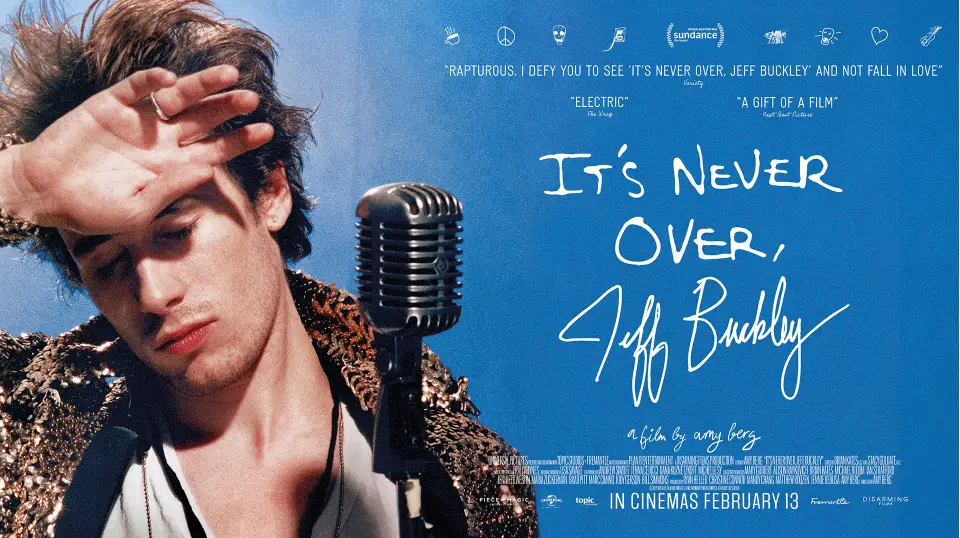
Reviewed on 25th January at the 2025 Sundance Film Festival
Genre: Documentary, Music
Director: Amy Berg
In Irish Cinemas: 13th February 2026
Some singers feel like they’re using their voices. Jeff Buckley sounded like he was being used by his. Listening to him never felt technical or strategic; it felt involuntary, almost dangerous, as if something ancient and electric had found a human body flimsy enough to pass through. His voice didn’t just climb registers; it evaporated gravity. It could be tender to the point of intimacy and then, seconds later, flare into something feral and ferocious. You don’t hear that singing very often because it doesn’t sound learned. It sounds possessed.
Amy Berg’s It’s Never Over, Jeff Buckley understands that immediately. The documentary doesn’t try to tame Buckley’s myth or sand down the extremes of his story. Instead, it lets the contradictions stand: the shy exhibitionist, the romantic who resisted permanence, the artist who seemed born to be worshipped yet deeply unsettled by attention. Berg’s great achievement here isn’t that she explains Jeff Buckley, it’s that she makes you feel how impossible he was to contain.
The film is structured less like a career retrospective than a slow immersion. We hear Buckley everywhere: alone with a guitar, in cramped rooms, on big stages, fooling around, searching for melodies mid-sentence. The sheer abundance of his voice becomes overwhelming in the best way. By the time the film settles into its rhythm, you’re no longer evaluating performances; you’re inhabiting a presence.
Popular memory has frozen Buckley into a single pose: the fragile angel hovering over “Hallelujah,” eyes closed, voice trembling with sacred restraint. Berg pushes hard against that flattening. Buckley could be hushed and reverent, yes, but he could also roar. He loved volume, distortion, swagger. He idolised singers who sang like they were crossing a line they might not come back from. Zeppelin mattered to him as much as folk laments; Nina Simone’s authority lived in the same body as Robert Plant’s abandon. His artistry wasn’t about purity; it was about risk.
That tension defines the film. Buckley emerges as an artist constantly oscillating between extremes: intimacy and spectacle, discipline and chaos, vulnerability and bravado. He came up during the grunge era but didn’t share its emotional compression. Where his peers folded inward, Buckley reached outward, melodically and emotionally. His songs didn’t withdraw; they soared.
For much of his life, Buckley was described as a “cult” figure, a musician admired intensely but narrowly. Berg makes a persuasive case that this was a temporary condition. The evidence piles up quietly: reverence from Bowie, awe from McCartney, the way audiences responded not with appreciation but with stunned silence. Buckley wasn’t circling greatness; he was accelerating toward it.
But the film refuses to romanticise that ascent without acknowledging its cost. Buckley’s personal history hangs over everything. His father, Tim Buckley, exists in the documentary like a low-frequency hum rarely foregrounded, never absent. Jeff inherited his father’s talent but not his presence, and that absence shaped him as much as any musical influence. He learned early how to turn longing into sound.
Berg handles this lineage with restraint. There’s no cheap psychoanalysis, no neat cause-and-effect diagnosis. Instead, the film traces patterns: Jeff’s reverence for female voices, his complicated relationship with masculinity, his desire to disappear even as he was being seen. He admired power but distrusted authority. He craved connection but resisted anchors. These weren’t quirks; they were structural.
As the documentary moves into its final act, a subtle unease sets in. Buckley grows restless, unmoored. He withdraws, resurfaces, reaches out. Phone calls take on the weight of farewells. Conversations trail into silence. The film never states what Buckley knew or didn’t know about his own future, but it lets the evidence accumulate until the effect is haunting.
His death was an accident, sudden, senseless, and left with quiet devastation. Berg doesn’t sensationalise it. She doesn’t need to. By this point, the tragedy isn’t just that Buckley died young; it’s that he seemed to be circling an edge he couldn’t quite name. The film leaves you with the uncomfortable feeling that something unresolved had finally overtaken him, not as destiny, not as intent, but as momentum.
What It’s Never Over, Jeff Buckley ultimately captures is not a legend but a human being whose gifts were inseparable from his volatility. Buckley wasn’t built for longevity; he was built for intensity. That doesn’t make his death inevitable, but it makes his life, in retrospect, feel incandescent.
When the film ends, what lingers isn’t grief so much as longing. You don’t just miss Jeff Buckley, you miss the future he was rushing toward, the music that never had time to arrive. And maybe that’s why his voice still hits with such force. It doesn’t belong to the past. It still sounds like it’s reaching for something just out of reach.
Overall: 7.5/10

Movie Reviewer