
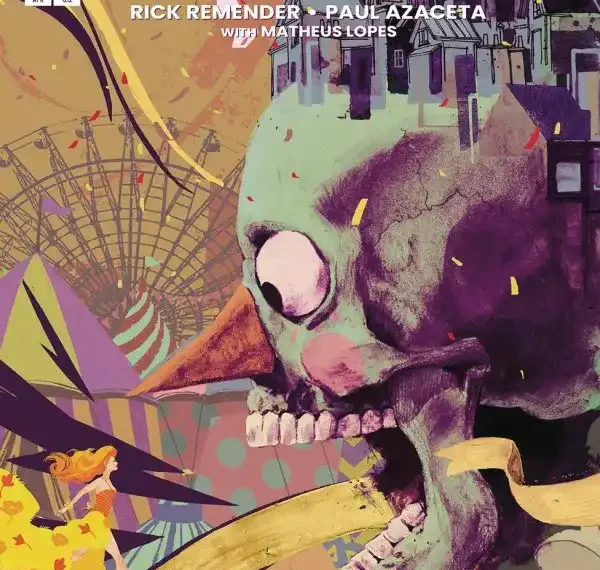
Writer: Rick Remender
Illustrator: Paul Azaceta
Colors: Matheus Lopes
Letters: Rus Wooton
Cover A: Paul Azaceta
Cover B: Max Fiumara & Dave McCaig
Publisher: Image Comics
Summary
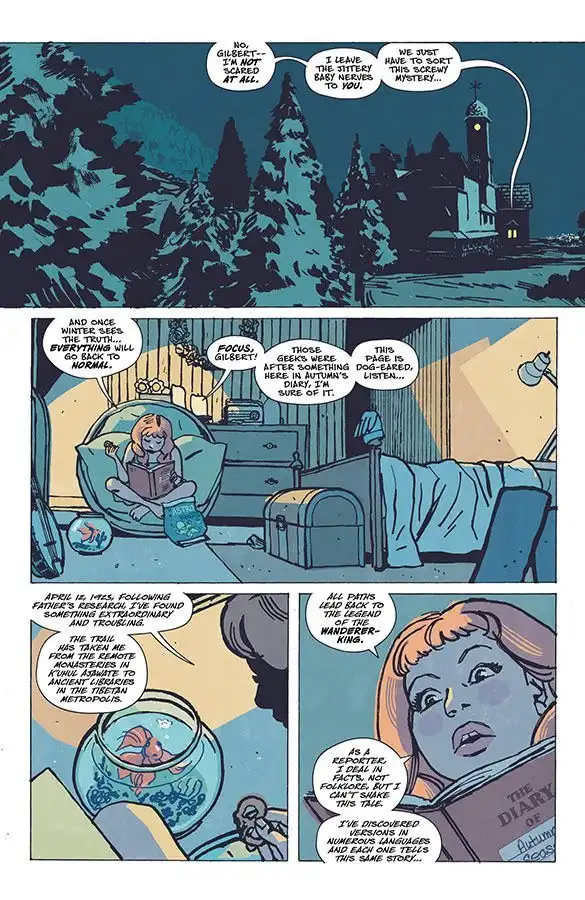
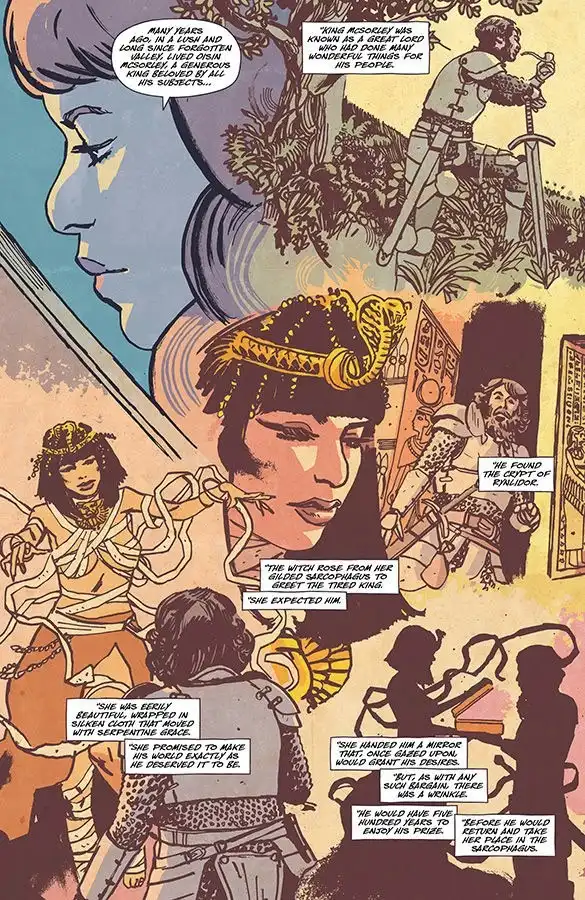
At the end of issue three, Spring prevents the theft of Autumn’s diary, and issue four begins with Spring reading that diary. The diary reveals the tale of the Wandering King. In essence, the king had the adoration and glory of his kingdom, but he harbored a secret “restless ambition.” He wastes much of his life searching for a priestess that might grant his wish. A ghastly barter is made, and the king is granted a hand mirror that, when gazed upon, shows him his desires fulfilled.
While reading, Spring hears on the radio that her other sister, Summer, is attending the grand opening of the carnival that very night. Spring rushes to arrive in time to stop her from entering, but the carnival workers keep them separated. After being particularly nasty to her assistants, Summer enters the circus tent without seeing Spring.
Inside, Summer takes her seat, but she seems unimpressed by the show as the crowd cheers – all while the ringleader tells the story of the ugly duckling that became a beautiful swan.
He then invites Summer onstage, and she fantastically transforms outfits. When she gets there, he holds out a box and offers her a deal he knows she won’t be able to refuse.
In exchange for a world that Summer feels she “deserves” (one in which she has even more adoration and fame that she currently has), she must let the circus ringleader bite off one of her fingernails.
Summer barely hesitates, takes the deal, and snatches the box. Inside it is a hand mirror. As she gazes into the mirror, a satisfied glow washes over her face.
Spring wasn’t able to stop Summer from walking into her own demise. With her parents missing, one of her sisters trapped by the carnival, another by magic, and Winter about to send her away to boarding school, how will Spring save her family from being totally consumed by this unsettling magical carnival?
Thoughts
The nested narrative of the Wandering King in Autumn’s diary parallels Summer’s experience at the circus, lending both depth and clarity to the reader.
Instead of engaging the very people that loved him, the king wastes much of his life searching for a mythical priestess with the power to magically grant his wish. He takes a Faustian deal with the priestess and ultimately has to pay a terrible price, and it’s difficult to say that he ever got what he wanted in the first place. It seems more that he was easy narcissistic prey to a manipulative predator.
Without realizing it, Summer Seasons is that same narcissistic prey falling victim to an all too knowing and calculated predator, and in her case, it’s the circus ringleader.
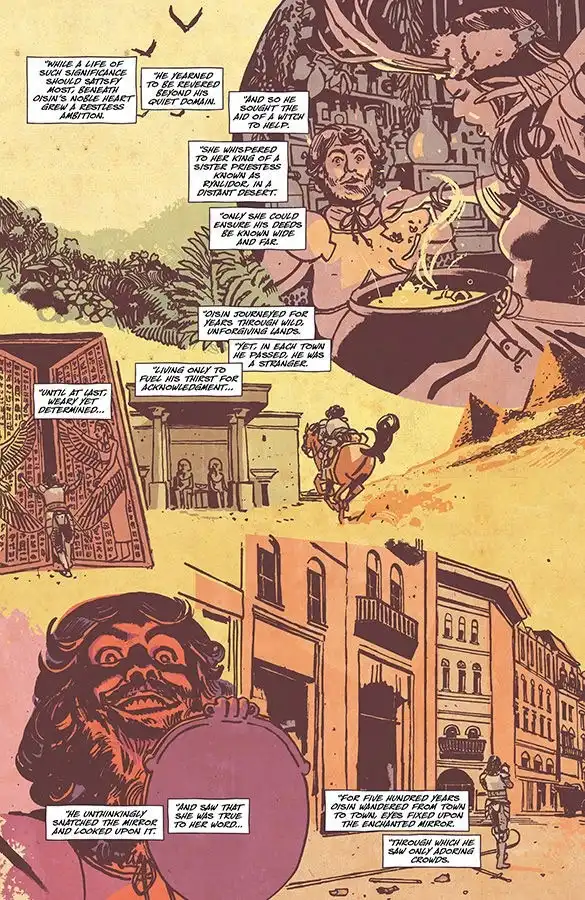
Summer already possesses fame and adoration, but her actions show that she doesn’t appreciate it. She berates her assistant and can’t enjoy the circus show until it puts her in the spotlight. Summer is so uninterested in the show that she doesn’t realize the ringleader seems to be making fun of her. Then, in a fun and mellifluous iambic pentameter, the ringleader casts a spell over Summer as she dances onstage that reveals her true feelings about her fans, that to her, they’re “pigs”. In front of New Gualia, Summer Seasons abandons her admirers for the promise of something more, hidden just beyond a looking glass, just as the Wandering Kind abandoned his adoring kingdom in the same fashion.
The storytelling, pacing, coloring, and lettering are consistently on point in this series. The opening double splash pages are a stand out. These are masterfully composed pages that contain an embedded narrative that flows from corner to corner in a way that propels the story forward visually and provides excellently placed foreshadowing. This splash section is just one example of how the Remender, Azaceta, Lopes, and Wooten are firing on all six as a team.
Overall: 10/10

K.L.Murphy has BA in English, writes and reviews comics, and habitually pets cats. Comics are all unique and each one represents an enormous amount of thought and effort. Murphy reviews comics based on a variety of factors, but focuses on the artwork, storytelling, and pacing.