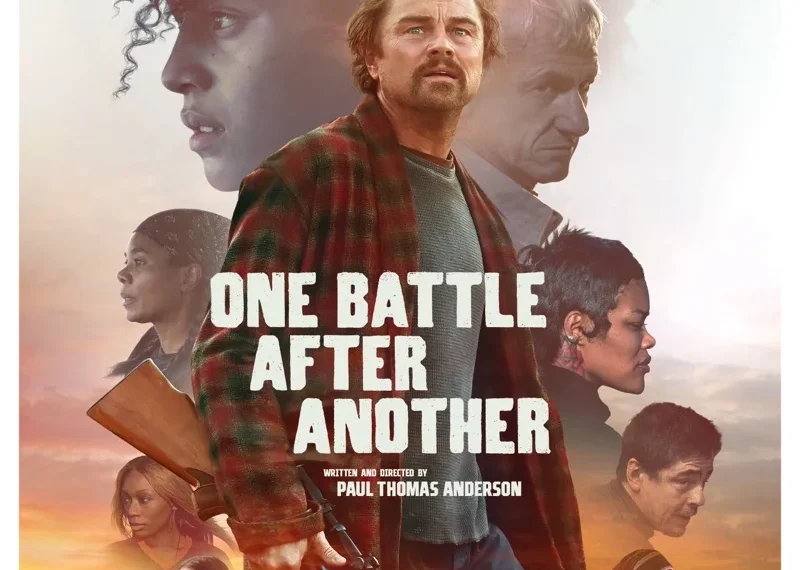
Cast: Leonardo DiCaprio, Sean Penn, Benicio del Toro, Regina Hall, Teyana Taylor, Chase Infiniti, Wood Harris and Alana Haim
Genre: Action, Crime, Drama, Thriller
Director: Paul Thomas Anderson
In Irish Cinemas: 26th September 2025
“One Battle After Another”, the title of Paul Thomas Anderson’s ferocious new political thriller, could efficiently serve as a summary of human history itself. Whenever I catch myself longing for some mythical, quieter era, I remind myself: When exactly would that have been? Every age has its fights—votes, wages, sovereignty, healthcare, dignity, and the right to resist.
When Thomas Pynchon released Vineland in 1990, his sprawling tale of dope-fueled radicals stumbling from the counterculture into the Reagan years, he seemed to accept that America’s soul had been lost. After Watergate, he wrote, repression merely changed shape—growing broader, deeper, and harder to see. Anderson, however, takes a fizzier, more mischievous view in his semi-loose adaptation: the revolution is still kicking. Yes, there’s exhaustion, betrayal, and hypocrisy—but isn’t it worth celebrating that there are always new fighters willing to carry the torch?
The film follows the French 75, a fictional guerrilla collective operating over sixteen turbulent years under the command of the incendiary Perfidia Beverly Hills (Teyana Taylor). Her crew includes Lady Champagne (Regina Hall), Mae West (Alana Haim), Junglepussy (Shayna McHayle), and Perfidia’s partner, Bob—nicknamed “Ghetto Pete”—played by Leonardo DiCaprio. Their daughter, Willa (later embodied by the excellent Chase Infiniti), grows up in the shadow of these battles. Under Perfidia’s ruthless drive, the French 75 spring migrants from detention centres, blow up campaign headquarters, and black out city grids. The timeline is intentionally hazy; it feels like a dispatch from the day after tomorrow.
Taylor’s Perfidia is a blazing creation: glamorous, merciless, and incandescently volatile—even nine months pregnant and firing an automatic rifle. Few actors have fused erotic allure, brute force, and reckless fury so completely. Her magnetism makes DiCaprio’s ponytailed Bob look like a half-hearted sidekick, perpetually unworthy of her attention. She orders him to “impress me”—he never quite does. DiCaprio shines in these pathetic, clownish roles, as he did in the tailspin stages of The Wolf of Wall Street.
Perfidia’s fiercest nemesis is Colonel Steven Lockjaw (Sean Penn), a grotesque mix of menace and humiliation. When Perfidia storms his office to taunt him, she accidentally awakens his deranged fetish for submission. With his grotesquely inflated biceps and a strut like he’s got a steel rod jammed up his spine, Penn plays Lockjaw as a pathetic predator—one whose obsession with Perfidia curdles into something both absurd and terrifying. His attempts to dominate her always collapse into needy humiliation; he brings flowers one moment, then smashes down her door with a battering ram the next.

Lockjaw despises Bob, and he loathes Perfidia’s role as a mother even more. Perfidia herself is ambivalent—her postpartum body feels like a prison, and she throws herself back into battle. Bob, left holding the baby, doesn’t realise that years later he’ll be hiding with Willa, the revolution sputtering out, their friends scattered or dead. The past—especially Lockjaw—will inevitably resurface, forcing father and daughter to fend for themselves. Bob stumbles, literally, tumoring forty feet off a building.
Calling Battle a straight Vineland adaptation would be generous. Anderson tips his hat to Pynchon, then veers off with his own concoction. Both works share a taste for anarchic sex, slapstick, and political paranoia, but the film’s moral compass and cultural focus are distinctly Anderson’s. He centres the story on race and family, echoing his own mixed household with Maya Rudolph. A throwaway moment—Bob admitting he can’t manage Willa’s hair—lands with quiet, aching honesty.

Like the cocktail that lends the group its name—a French 75, originally a WWI salute to a deadly artillery gun—Anderson swaps ingredients but keeps the kick. Grenadine instead of champagne, ICE raids instead of DEA busts. His villains include not only Lockjaw, but also a gaggle of ridiculous white nationalists in the so-called “Christmas Adventurers Club.” With their oily skin and grotesque grooming, they look like parodies of their own ideology.
Anderson often lets audiences wrestle with ambiguity, but here he draws starker moral lines. Lockjaw is given no seductive charisma—Penn plays him as a hollow opportunist, a racist whose bigotry is less ideological than self-serving. He joins Anderson’s gallery of corrupted patriarchs, alongside Daniel Plainview (There Will Be Blood) and Lancaster Dodd (The Master), but unlike them, he has no grandeur—just pathetic, obsessive spite.

The film’s momentum ultimately revolves around Willa, the reluctant heir to Perfidia’s fire. Various factions scheme to either protect or destroy her. Greenwood’s anxious, percussive score hammers beneath these chases, as Bob fumbles to remember the code words for sanctuary: “I’ve fried my brain, man,” he groans.
Anderson resists easy sentiment. Victims of ICE raids and state violence aren’t showcased in melodramatic close-ups. Instead, a single shot of kids in cages batting around a crumpled foil blanket is enough to land with crushing weight. Similarly, Benicio del Toro injects jolts of vitality as Sergio St. Carlos, Willa’s martial arts mentor and a modern-day conductor of underground escape routes. One shot of his scouts vaulting across rooftops silhouetted against a flag-shaped light display is as stirring as anything Anderson has filmed.

Despite the title, the film contains no tidy fistfights. The violence is systemic, bureaucratic, faceless—bullets, raids, drone strikes. Characters appear, vanish, or die without fanfare. Some have big names; others aren’t even given names. The churn is constant, merciless.
By the time the credits roll, Anderson refuses to tie the story into a neat resolution. No captions explain who survived or what became of the revolution. That omission is his boldest statement: there are no endings, only handoffs. Progress is communal, eternal. As the title insists, when one fighter falls, another steps up. They always have.
Overall: 7.5/10

Movie Reviewer