Reviewed on 27th August 2025 at the 82nd annual Venice International Film Festival
Cast: Toni Servillo, Anna Ferzetti
Genre: Comedy, Horror, Romance, Sci-Fi, Thriller
Director: Paolo Sorrentino
In Irish Cinemas: Now
A quieter Sorrentino finds unexpected depth in La Grazia
After years of visual extravagance and stylistic bravado, Paolo Sorrentino pivots in La Grazia toward something far more subdued and, in many ways, more resonant. Where his earlier films revelled in spectacle, this one strips things back, trading operatic flourish for stillness and reflection.
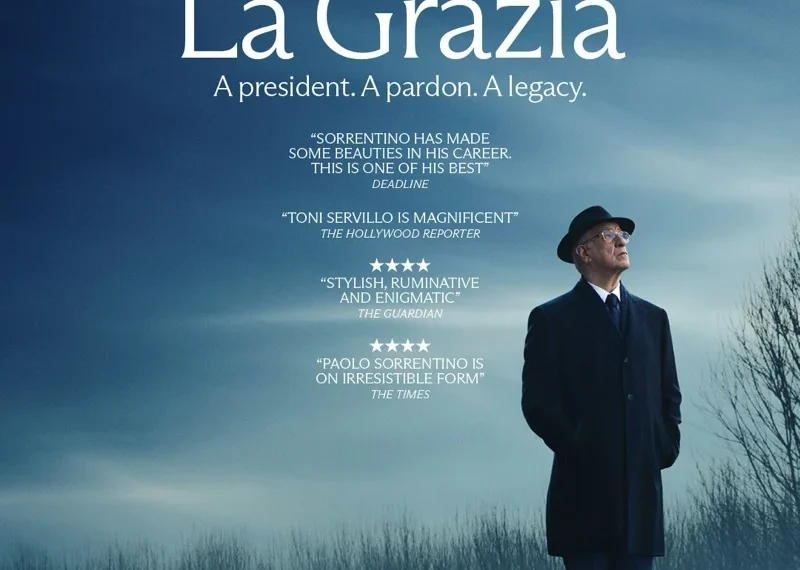
At the centre is President Mariano, played with understated control by Toni Servillo, a long-time collaborator of the director. Nearing the end of his presidency, Mariano drifts through his final days in office with a mixture of detachment and quiet unrest. Nicknamed “Reinforced Concrete” for his emotional impenetrability, he spends much of his time in contemplation on rooftops, in dimly lit rooms, or in the company of old friends whose familiarity carries its own tensions.
Beneath his composed exterior lies a lingering personal unease. The memory of his late wife haunts him, complicated by a suspicion that she may have betrayed him decades earlier—with someone still in his orbit. This unresolved doubt seeps into his present, blurring the line between private grief and public responsibility.
The film situates Mariano within the peculiar structure of Italian politics. Though the presidency holds formal authority, real power often resides elsewhere, leaving him in a role that is as symbolic as it is decisive. Faced with a handful of morally complex decisions, including clemency requests and a controversial euthanasia bill, he hesitates, weighing not just legality but consequence. His daughter Dorothea, played by Anna Ferzetti, serves as both advisor and critic, challenging what she sees as his tendency to delay rather than decide.
This tension between action and restraint mirrors the film’s own aesthetic. Sorrentino, once known for sensory overload in films like The Great Beauty and Il Divo, now embraces quiet composition. Conversations unfold over dinner tables, pauses carry as much weight as dialogue, and the camera lingers rather than dazzles. Even moments of visual flourish, aerial displays over Rome, or a striking dance performance feel purposeful rather than indulgent.
There’s a deliberate pacing here that may test viewers expecting the director’s usual excess, but it ultimately rewards patience. The stillness allows the performances to breathe, particularly Servillo’s, which is built on subtle shifts rather than grand gestures. His Mariano is not a man of dramatic declarations but of internal negotiation, a figure defined by what he withholds as much as what he reveals.
In the end, La Grazia is less concerned with political mechanics than with the emotional weight of leadership and the quiet reckoning that comes with time. It suggests that power is not always exercised in bold strokes; sometimes, it lies in hesitation, in reflection, in knowing when not to act.
By dialling everything down, Sorrentino uncovers something unexpectedly powerful: a film that speaks softly, but lingers long after it ends.
Overall: 7.5/10

Movie Reviewer