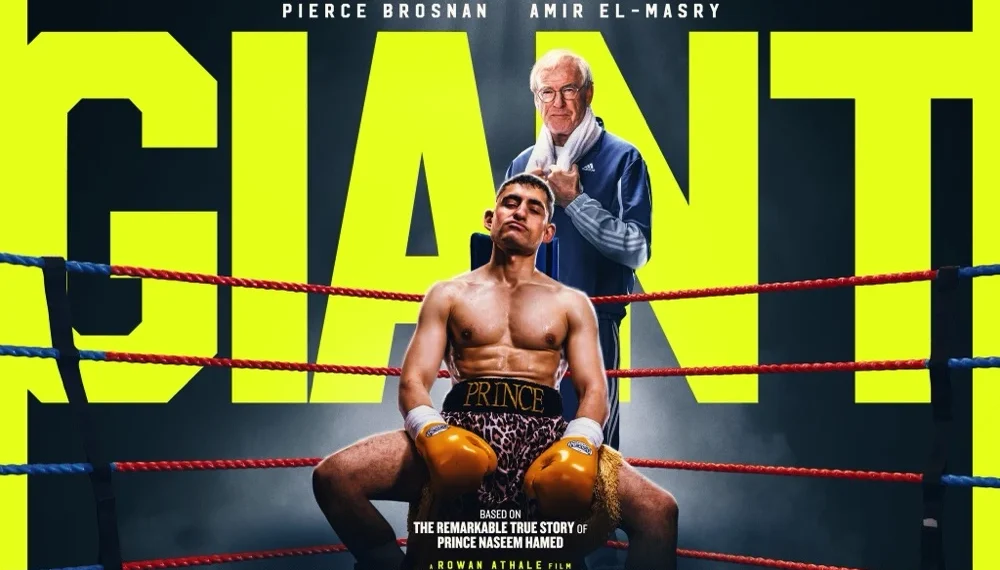
Cast: Pierce Brosnan, Amir El-Masry
Genre: Drama, Sport
Director: Rowan Athale
In Irish Cinemas: 9th January 2026
Giant chronicles the rise of Yemeni British boxing phenom Prince Naseem “Naz” Hamed, tracing his journey from a bullied child to a global champion. On paper, it follows the expected beats of the sports biopic: hardship, discipline, perseverance, and eventual glory. What distinguishes the film, however, is not the arc of athletic success but the decades-long relationship between Hamed (Ahmed ElMasry) and his mentor, Brendan Ingle (Pierce Brosnan), an Irish boxing trainer who discovered and coached him from the age of seven. It is this bond that gives writer-director Rowan Athale’s film its emotional centre and narrative specificity.
One of the film’s earliest and most revealing sequences establishes both that relationship and a key thematic concern. Seen through Ingle’s eyes from the top deck of a bus, a young Hamed (played as a child by Ghaith Saleh) is being chased and harassed by white schoolyard bullies targeting him for his race and heritage. What catches Ingle’s attention is not merely the cruelty of the scene, but the boy’s nimble footwork as he dodges his attackers. The moment links athletic promise to survival, framing Hamed’s boxing instincts as a response to the entrenched racism of 1980s and ’90s Britain, a pressure the film returns to repeatedly.
For much of its first half, racial hostility functions as the primary source of tension. Beyond that, the narrative proceeds predictably, charting Hamed’s ascent in the ring under Ingle’s guidance. Their relationship deepens into something akin to family, with Ingle instilling in his pupil the belief that self-confidence, even arrogance, is a necessary shield against the prejudice surrounding him. These passages are competently staged and smoothly paced, though they rarely subvert familiar genre conventions.
The film sharpens in its latter half, when success introduces fracture. Ingle, who secured a significant share of Hamed’s earnings when the boxer was still a minor, finds that arrangement challenged once Hamed reaches adulthood. The dispute brings Hamed’s family into the foreground, particularly his brother Riath (Arian Nik), who serves as both manager and vocal adversary to Ingle. Religious faith also complicates matters: Hamed’s frequent assertion that his talent is God-given clashes with Ingle’s desire for recognition as the architect of his success. What began as a mentorship starts to unravel under the weight of money, pride, and competing claims of ownership.

It is here that “Giant” subtly reframes itself. The title initially seems to refer to Hamed’s outsized personality and public profile. Still, the film increasingly positions Ingle as its proper subject, a towering figure within the Sheffield boxing community whose influence far exceeds his fame. While Hamed’s personal life and inner world remain comparatively underexplored, the film invests deeply in Ingle’s perspective, particularly through his relationship with his wife Alma (Katherine Dow Blyton), who provides emotional grounding and moral clarity.
ElMasry convincingly captures Hamed’s swagger and theatrical confidence, particularly in the fight sequences, where his physicality and graceful, dance-like movement feel authentic. Yet the script affords him limited psychological depth, reserving the more complex emotional terrain for Brosnan. Freed from his usual polished persona, Brosnan delivers a grounded, humane performance, conveying Ingle’s generosity, vulnerability, and simmering resentment with restraint. Nik, by contrast, is hampered by a one-note role defined broadly by volume rather than nuance. Visually and technically, the film remains serviceable but unremarkable, never quite finding a distinctive aesthetic voice.

Ultimately, Giant does little to reinvent the sports biopic, but its focus on the uneasy symbiosis between coach and fighter gives it coherence and weight. At its strongest, the film explores how ambition and loyalty can exist in uneasy tension, forging greatness while sowing the seeds of rupture. However, it offers limited insight into Hamed beyond his public persona; its portrait of Ingle as a formative yet overshadowed figure lends the story emotional resonance. The film may not deliver a cinematic knockout, but it connects often enough to leave an impression.
Overall: 7/10

Movie Reviewer