Cast: Sam Worthington, Zoe Saldaña, Sigourney Weaver, Stephen Lang, Oona Chaplin, Cliff Curtis, Joel David Moore, CCH Pounder, Edie Falco, David Thewlis, Jemaine Clement, Giovanni Ribisi, Britain Dalton, Jamie Flatters, Trinity Jo-Li Bliss, Jack Champion, Brendan Cowell, Bailey Bass, Filip Geljo,Duane Evans, Jr., and Kate Winslet
Genre: Action, Adventure, Fantasy, Sci-Fi, Thriller
Director: James Cameron
In Irish Cinemas: 19th December 2025
There is an early instant in Avatar: Fire and Ash when James Cameron’s famously immaculate digital Pandora briefly betrays its own divinity. It arrives just after a violent skirmish in which a splinter faction of Na’vi rains incendiary destruction down upon another tribe. Our protagonists are hurled from the sky and left stunned amid dense jungle undergrowth. In the fractional pause that follows something closer to a blink than a breath, a bioluminescent tendril snakes toward the children of Jake Sully and Neytiri. That is when it happens: a flicker of artifice. A computer-generated element that doesn’t fully pass for the real thing. The illusion cracks. Even gods, it seems, can show their seams.
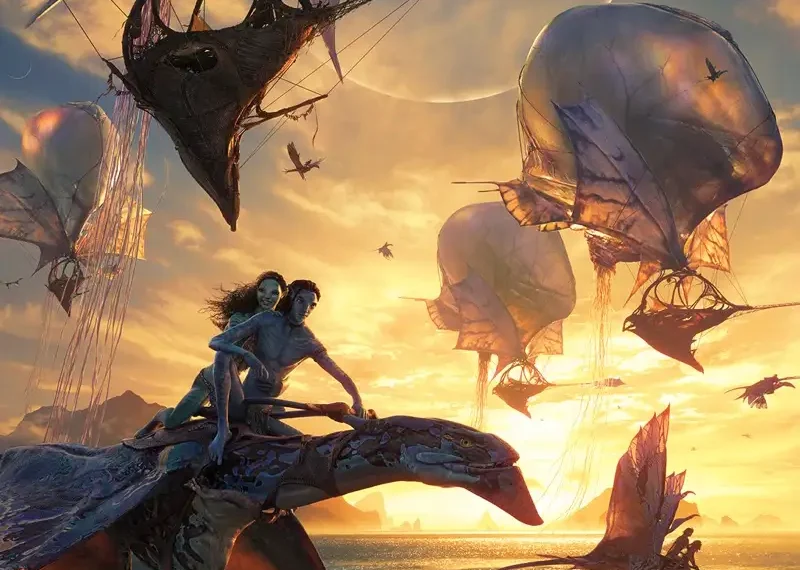
Calling attention to such a moment is, admittedly, the purest form of nitpicking. When nearly every other frame of Cameron’s third return to Pandora is rendered with obsessive care and painterly precision, spotting a stray imperfection can feel almost rude. It’s like noticing a hairline fracture in a gemstone mounted on a king’s sceptre, technically there, but irrelevant to the spectacle of power it projects. If anything, there were likely other visual slips that went unnoticed, buried beneath the sheer sensory onslaught of the film’s 3D grandeur. Any aesthetic complaints evaporate quickly in a movie this consistently transportive across its gargantuan 197-minute runtime, dissolving like morning fog under a radioactive sunrise.
Whatever one thinks of Fire and Ash’s narrative cul-de-sacs, yet another tale of blue aliens resisting humanity’s ravenous expansion, the film stands as both a visual high-water mark and an implicit rebuke of the modern blockbuster ecosystem. Why, exactly, can’t the pixelated plains of Minecraft or the desolate nowhere-land of Deadpool and Wolverine look even half this alive? And yet I found myself wondering why I’ve grown so accustomed to this level of spectacle that I’m drawn to trivial blemishes instead of marvelling at the whole. Perhaps it’s because while Fire and Ash operates on the scale of a mythic epic, it stubbornly clings to the moral simplicity of a children’s fable, specifically, the well-worn template of Disney’s Pocahontas.
To be clear: Fire and Ash is a good film. It’s also an improvement over The Way of Water, which often felt less like a sequel than a lavish tech demo showcasing Cameron’s latest aquatic breakthroughs. Some critics have dismissed the new entry as merely a retread of its predecessor, but if that’s the case, it’s a more confident and dramatically focused iteration. This time, there is at least the semblance of narrative propulsion, largely thanks to Spider (Jack Champion), the only Sully child granted anything resembling interiority.
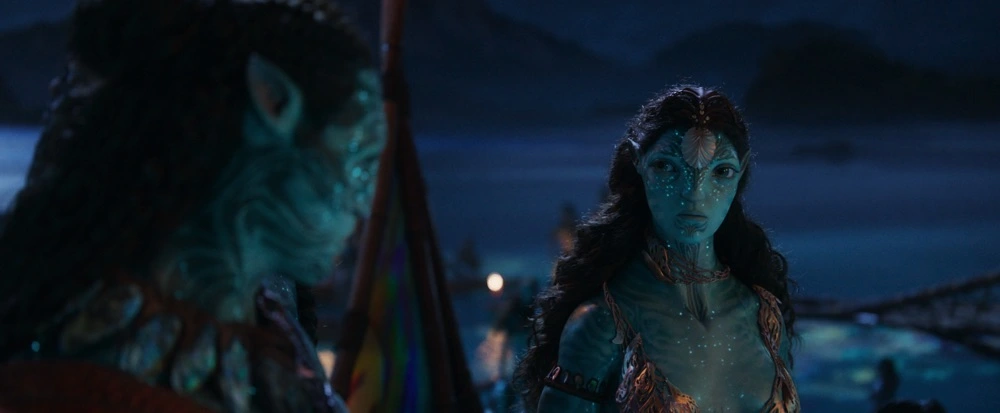
In truth, Fire and Ash belong to Spider. The entire plot hinges on his fate. In the aftermath of The Way of Water, which culminated in the death of Jake and Neytiri’s eldest son during a set piece that played like Titanic with gills, Neytiri has grown openly hostile toward Spider, their adopted human child. Too alien for human society and too human for the Na’vi, Spider finds himself exiled on all fronts, sent to live among distant relations. That uneasy stasis is shattered when the Sully clan’s transport is attacked by Varang (Oona Chaplin), a shamanistic Na’vi warlord whose Mangkwan clan venerates fire, annihilation, and the cleansing promise of violence after a volcanic catastrophe erased their homeland.
This collision sets into motion the film’s strangest and most consequential turn. Kiri (Sigourney Weaver, still perplexingly cast as a teenager), the Sullys’ most spiritually attuned child, calls upon Eywa to save Spider when his oxygen supply is destroyed. The result is a burst of glowing vines and vaguely New Age mysticism that transforms Spider into a biological hybrid: human in appearance, Na’vi in physiology. The metamorphosis also draws the attention of his biological father, the perpetually scowling Colonel Miles Quaritch (Stephen Lang), who remains committed at least rhetorically to the eradication of Pandora. After years of inhabiting a Na’vi body, however, Quaritch’s protestations ring hollow, especially once he finds a kindred spirit in Varang. The two bond over shared passions: scorched-earth tactics, apocalyptic ideology, and perhaps some light bloodletting as foreplay.
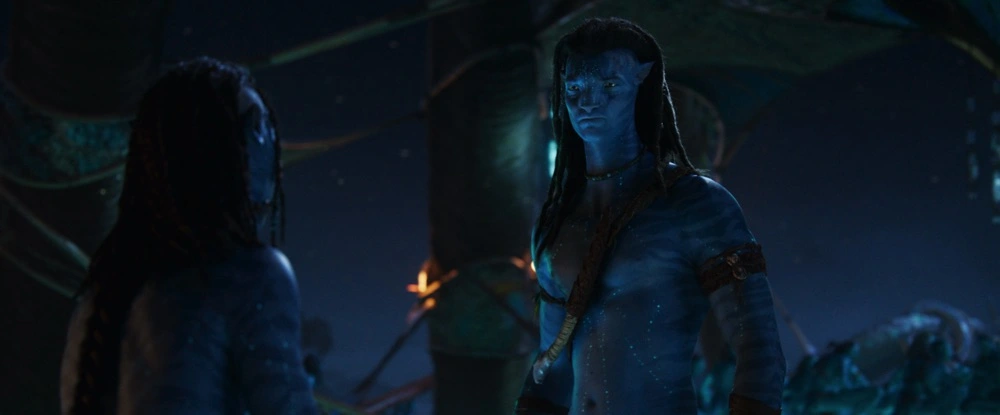
Their alliance poses an existential threat to the aquatic tribes sheltering the Sullys, culminating in yet another operatic showdown between the human military-industrial machine now bolstered by a Na’vi death cult and Pandora’s righteous defenders, complete with space whales charging into battle.
It’s often observed that the Avatar series lacks the cultural afterlife of Star Wars or The Lord of the Rings, despite outgrossing both franchises. Yet setting aside Reddit threads and fan art, the appeal of Fire and Ash is self-evident. Pandora remains lush, immersive, and hypnotic even without the 3D enhancement. In an era dominated by interchangeable franchise spectacles, Cameron offers something rare: a world that genuinely invites viewers to live inside it for nearly a quarter of a day. That commitment, both the film’s and the audience’s, is substantial, but the movie’s utter lack of irony or self-consciousness feels bracing in 2025, just as it did in 2009. Sometimes it’s enough to visit Oz.

If the films struggle to linger in the imagination, it’s because Cameron’s scripts never quite rise to meet his visual ambition. Sixteen years on, Avatar remains steeped in colonialist and white-savior mythology, echoing Dances with Wolves, The Last Samurai, and, most directly, the Pocahontas legend filtered through John Smith’s romanticised gaze. That lineage is undeniable, but derivation doesn’t preclude depth.
To Fire and Ash’s credit, Cameron and co-writers Rick Jaffa and Amanda Silver gesture toward thornier historical parallels. Varang and her followers evoke the fraught reality of Indigenous groups who allied with colonial powers against rival nations during moments of imperial upheaval, think of the tribes who sided with Cortés against the Aztecs. Spider’s liminal existence, rejected by both cultures that claim him, echoes the painful histories of figures like Cynthia Ann Parker and the real Pocahontas herself.
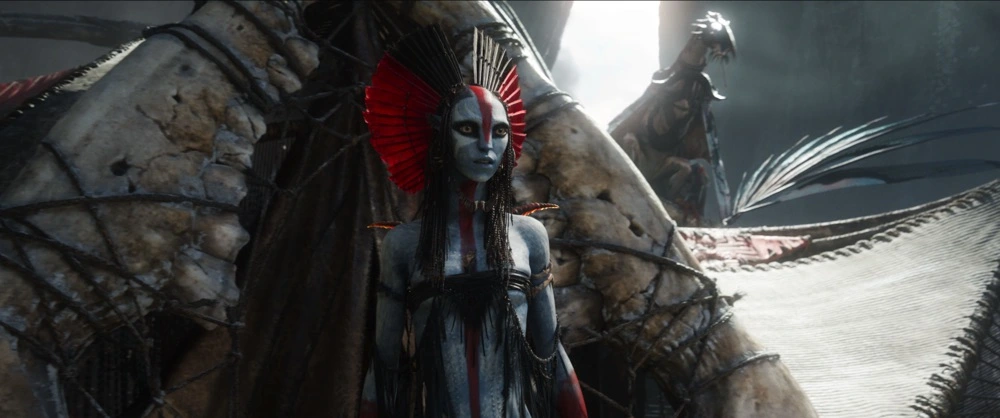
These ideas hover tantalizingly beneath the surface, but as is often the case with Cameron, complexity gives way to crowd-pleasing melodrama. The film opts for familiar emotional crescendos: doomed romances, surrogate motherhood, and once again, noble Indigenous peoples rallying behind an adopted outsider to enlist nature itself in their war against technologically superior invaders. Cameron executes these beats expertly; it’s just that by the third pass, their impact has dulled.
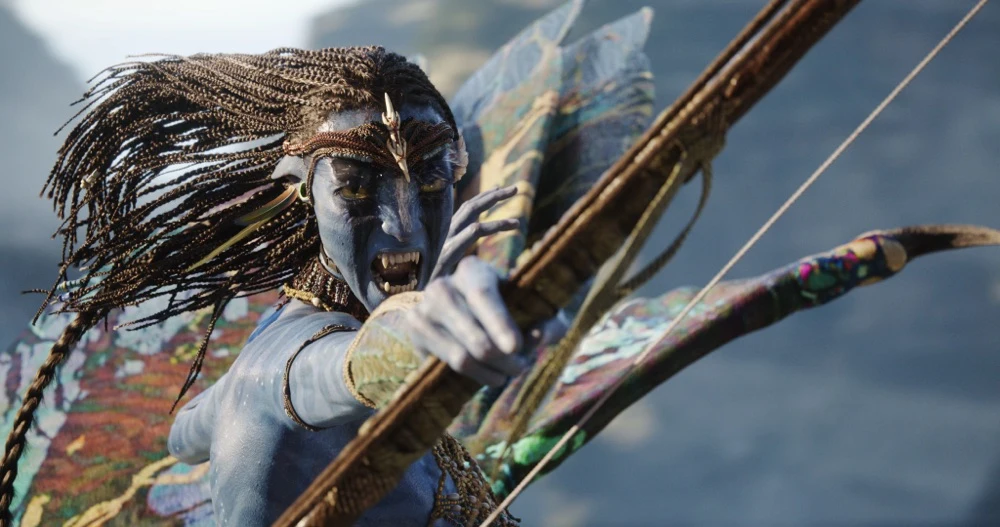
Still, there are pleasures to be found. Chaplin’s ferocious Varang proves a worthy counterpart to Lang’s gleefully unhinged Quaritch, and their shared descent into righteous monstrosity is perversely entertaining. The final battle is also more satisfying than before, incorporating Pandora’s full ecological arsenal and hinting that when the reckoning comes, Cameron will unequivocally side with the orcas against the yacht class.

Some elements feel conspicuously engineered for audience approval, particularly another star-crossed romance, made stranger by the fact that a performer in their seventies portrays one half, but for families seeking holiday escapism, such quirks are unlikely to matter.

This is a film designed to be gazed upon, absorbed, and then neatly packed away until the next Avatar instalment arrives. One can grouse about untwinkling lights or wish for something more nourishing beneath the spectacle, but doing so risks pedantry in the face of a sensory barrage this overwhelming. Fire and Ash delivers more of the same, occasionally better, and then politely asks you to forget about the blue people until James Cameron and 20th Century Studios are ready to extract a few more billion dollars sometime in the next three to twenty years.
Overall: 7/10

Movie Reviewer