
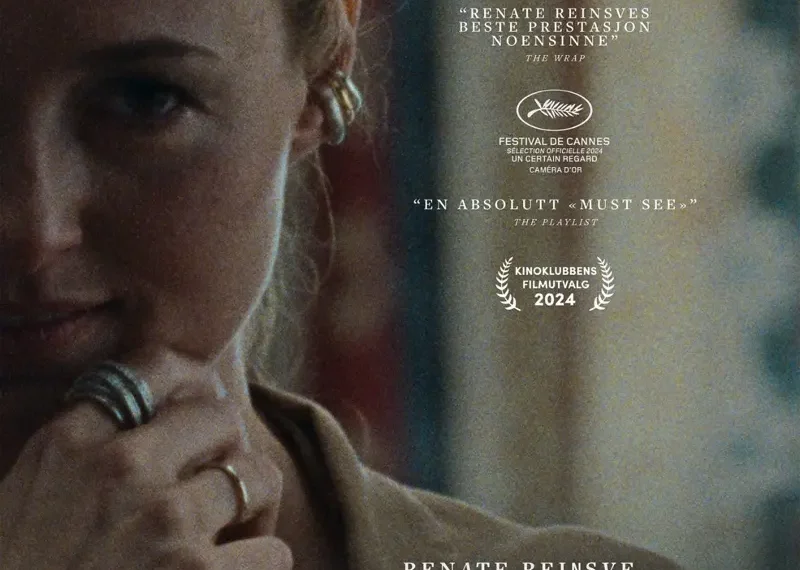
Reviewed on May 19th at the 2024 Cannes Film Festival – Un Certain Regard. 118 Mins
Cast: Renate Reinsve, Ellen Dorrit Petersen, Endre Hellestveit, Thea Lambrechts Vaulen, Øystein Røger
Genre: Drama
Director: Halfdan Ullmann Tøndel
In Irish Cinemas: 11th July 2025
There’s a single, searingly effective moment in Armand, the debut feature from Halfdan Ullmann Tøndel — grandson of cinematic titans Ingmar Bergman and Liv Ullmann — that cuts through the film’s haze of obliqueness like a knife. We’re in a stark Norwegian primary school, a place that soon feels less like an institution for children and more like a tribunal. Elisabeth, mother to a young boy named Armand, has been called in under vague and increasingly disturbing pretences. She sits across from a panel of school staff who inform her, in a maddeningly indirect manner, that her six-year-old son may have sexually assaulted a classmate.
We never met Armand. We don’t see a single child, in fact — a puzzling choice in a film ostensibly about childhood, innocence, and the social structures that surround them. The absence of children becomes its statement: this is not a story about kids, but about adults projecting their anxieties, failures, and rigid ideals onto children.
Elisabeth, played with extraordinary nuance by Renate Reinsve (best known for The Worst Person in the World), listens in growing disbelief. Her son, whom she believes to be emotionally healthy and far too young to be capable of intentional malice, is being reframed as a potential predator. As the questioning lurches from ambiguous concern to clinical suspicion, Elisabeth finally breaks. Not into tears — but into laughter.
And not polite, nervous laughter. Not a chuckle to defuse tension. No — she erupts into a five-minute-long, uncontrollable laughing fit. It surges out of her like a physical possession, mocking the absurdity of the scene, the institutional rigidity, the unspoken hysteria baked into the moment. Reinsve modulates the performance brilliantly — she starts and stops, as if her body is at war with itself, her face shifting between incredulity, scorn, and a kind of horrified glee. It’s a tour de force, and it asks a quietly profound question: Is laughing, for an actor, harder than crying? Reinsve makes it seem impossibly natural, spontaneous, yet emotionally layered.
But what makes the scene transcend its technical brilliance is the emotional truth pulsing underneath. Her laughter isn’t joyful. It’s bitter, exasperated, laced with a growing sense of societal claustrophobia. It’s the sound of someone confronting the bleak reality that the world has become a surveillance machine, where every movement, word, and gesture — even those of a child — are scanned for deviance. She’s not laughing at her interrogators; she’s laughing at the sheer lunacy of a culture so obsessed with safeguarding innocence that it’s willing to destroy it in the process. That’s why she can’t stop. The laughter becomes existential.
In that moment, Reinsve channels the raw complexity of Liv Ullmann herself — but with none of the inherited legacy. Ironically, it’s Reinsve, not the director, who evokes Bergman’s spirit.
Unfortunately, Armand struggles to rise to the level of that scene. The rest of the film is a fragmented, stylistically overdetermined work that often feels like it’s chasing profundity rather than earning it. It has a promising central conceit — a parent placed under social and psychological duress as a means of exploring collective moral panic — but the execution lacks cohesion. The narrative unfolds like a cryptic puzzle with half its pieces missing. There’s atmosphere in abundance, but little clarity, little follow-through.
Ullmann Tøndel shoots the school with an eerie, hyper-controlled aesthetic: blank walls, sterile lighting, labyrinthine hallways. It’s all very visually composed, but what’s missing is connective tissue — between scenes, between characters, between ideas. Conversations are clipped and elliptical, as though the dialogue was cribbed from a David Mamet fever dream. But where Mamet’s staccato rhythms suggest an explosive undercurrent of meaning, here the dialogue feels stunted, incomplete, as if constantly interrupting itself.
Worse still, the film continually undermines its internal logic. For instance, why is Elisabeth interrogated in a classroom, with tiny chairs and colored posters, instead of a private office? Why is the charge against Armand drip-fed instead of stated plainly, especially given its gravity? Why is the panel led by a visibly inexperienced young teacher, Sunna (Thea Lambrechts Vaulen), if the situation is allegedly so serious? If the film critiques Norway’s bureaucratic hyper-caution, then putting someone so ill-equipped in charge only muddles that point.
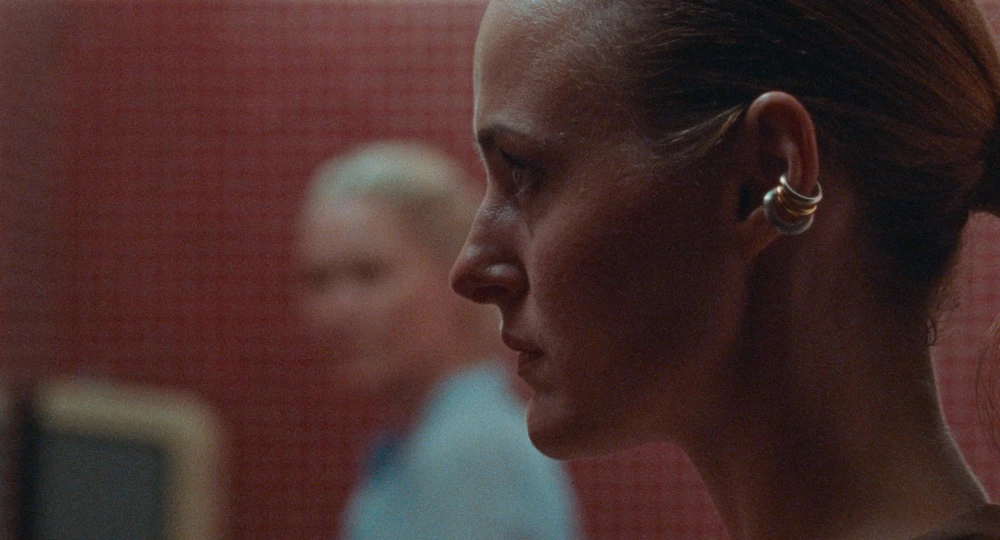
As the supposed facts begin to trickle out — including the revelation that Armand’s classmate, Jon, has claimed to be raped — Elisabeth responds with mounting disbelief. The language alone seems implausible for a six-year-old, as she sharply notes. But the script continues to pile on: Elisabeth and Jon’s mother, Sarah, turns out to be a sister-in-law. (This twist is revealed so late it almost feels like a retcon.) Thomas, the man connecting them — Elisabeth’s husband and Sarah’s brother — is dead by suicide, a trauma Sarah blames Elisabeth for. It’s a stew of grief, rivalry, blame, and shame — but so much of it is off-screen, discussed in fragments rather than shown. Even the use of old school photos, seen hanging eerily in the halls, aims for symbolism but feels more like borrowed menace from a Girl with the Dragon Tattoo playbook.
Ullmann Tøndel also veers into symbolic abstraction that feels more decorative than meaningful. Late in the film, we are treated to a modern dance performance by Elisabeth, followed by a writhing, wordless group body scene that suggests either catharsis or chaos, or both. Or neither? It’s hard to say. These moments are striking, but not anchored to anything we can emotionally or narratively grasp.
There’s a vision here. Ullmann Tøndel is interested in power structures, institutional overreach, and the psychological toll of modern parenting under surveillance. But he delivers these themes in a form so elliptical, so infatuated with withholding, that it becomes alienating. The film’s structure keeps us at arm’s length, asking us to solve a mystery without ever giving us the rules of the game.
Which leads to a more basic question: Who is Armand really for? Who, outside of a niche festival audience, will sit through its elliptical unravelling, its emotional obfuscation, its refusal to land? It’s a film that’s content to be “about something,” without being for someone.
Halfdan Ullmann Tøndel shows flashes of real promise — that laughing scene alone proves he can stage something extraordinary. But filmmaking is not just about individual moments. It’s about seeing a thought through to its conclusion. And if Ingmar Bergman were watching this from above, one suspects he might look down at his grandson and, with loving severity, say: Start again — and this time, write the whole script, not just the subtext.
Overall: 6/10

Movie Reviewer