
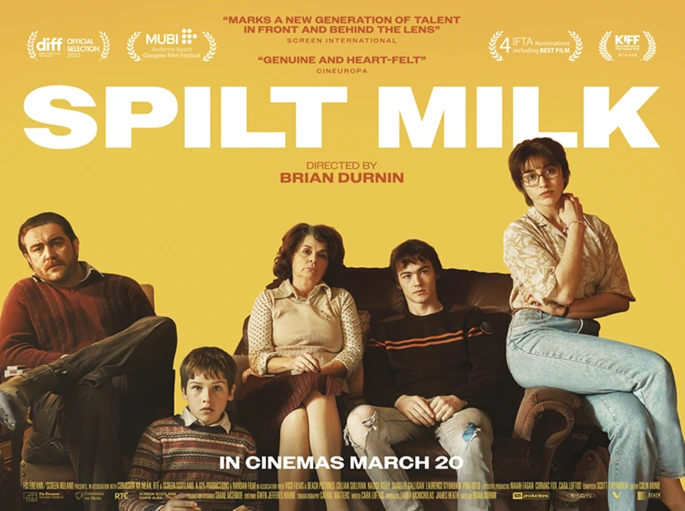
Cast: Cillian Sullivan, Naoise Kelly, Danielle Galligan, Laurence O’Fuarain, Pom Boyd, Lewis Brophy
Genre: Drama
Director: Brian Durnin
In Irish Cinemas: Now
Aoife Fealy transports us into a vividly remembered Dublin of decades past with her take on Spilt Milk. This film blends childhood curiosity with a far more sobering reality beneath the surface.
Set against the backdrop of the North Inner City flats during the 1980s, Spilt Milk, directed by Brian Durnin, introduces us to the small but eventful world of eleven-year-old Bobby O’Brien. What begins as a warm, often playful portrait of youth quickly reveals itself to be something weightier, a coming-of-age story shaped as much by imagination as by hardship.
At the centre is Bobby, brought to life with infectious enthusiasm by Cillian Sullivan. Obsessed with the swagger and certainty of TV sleuth Kojak, Bobby fashions himself as a pint-sized investigator, eager to crack even the smallest household mystery. But his games take on real urgency when his older brother Oisín, played by Lewis Brophy, suddenly disappears. What starts as a child’s adventure, complete with clue-hunting and whispered theories, soon evolves into something far more unsettling.
With the help of his loyal friend Nell, portrayed by Naoise Kelly, Bobby begins to peel back the layers, revealing a harsh truth. The film gradually shifts tone, confronting the devastating grip of heroin addiction, a crisis that cast a long shadow over Dublin communities during that era. The story doesn’t sensationalise; instead, it quietly reveals how deeply such struggles seep into family life, altering it in ways both visible and hidden.
The emotional core of the film rests firmly with Bobby’s family, particularly his mother Maura, played with striking depth by Danielle Galligan. Galligan captures a woman caught between resilience and quiet despair, wrestling with guilt as she tries to hold her household together. Alongside her, Laurence O’Fuarain delivers a restrained and thoughtful performance as John, a father navigating pride, regret, and the pressures of providing in an uncertain time. Their dynamic feels authentic, marked by tension, tenderness, and moments of unspoken understanding. Meanwhile, Pom Boyd adds warmth and grit as the family matriarch, grounding the home with a sense of continuity.
The script, penned by Cara Loftus, paints a layered picture of working-class Dublin life, balancing humour and hardship with care. There’s a clear affection for the community depicted, from its small domestic rituals to its shared struggles. Visually, the film is equally evocative. Cinematographer Cathal Watters captures the environment with a nostalgic richness, while production designer Shane McEnroe crafts interiors that feel authentically lived-in. The O’Brien household, in particular, carries the texture of real life, crowded, worn, but full of character. Costume designer Gwen Jeffares Hourie subtly anchors the film in its period, avoiding caricature in favour of quiet authenticity.
There are moments of striking contrast throughout: scenes of private grief unfolding in cramped, multipurpose rooms sit alongside bursts of joy, such as a fleeting, tender dance that reminds us of the family’s enduring connection. These juxtapositions give the film much of its emotional resonance.
Ultimately, Spilt Milk emerges as an understated yet powerful piece of Irish cinema. It calls to mind the spirit of films like Into the West, The Snapper, and Mickybo and Me, while carving out its own identity. There’s a sincerity here, a refusal to look away from difficult truths, paired with a genuine appreciation for resilience, particularly that of women holding families together through the toughest of times.
Balancing innocence with harsh reality, Spilt Milk is both quietly devastating and unexpectedly uplifting, a film that lingers, much like the memories it so carefully recreates.
Overall: 6/10

Movie Reviewer