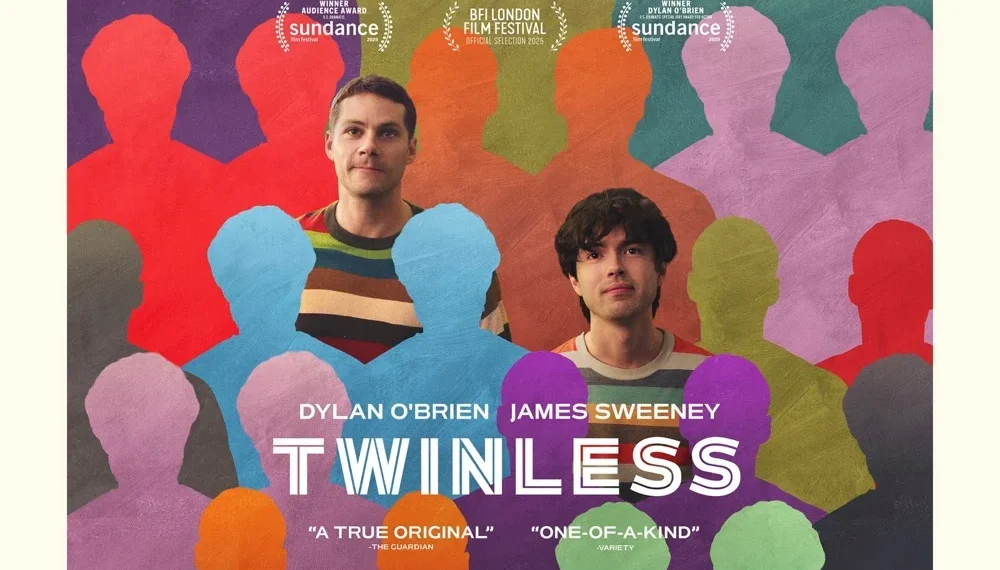
Reviewed on 31st January at the 2025 Sundance Film Festival
Cast: Dylan O’Brien, James Sweeney
Genre: Comedy, Drama
Director: James Sweeney
In Irish Cinemas: 6th February 2026
There was an unmistakable hum of curiosity before Twinless unspooled at Sundance. Little was known, and what information there was felt deliberately vague. James Sweeney, who writes, directs and appears on screen, resisted the usual preamble filmmakers offer at premieres. No earnest mission statement, no roadmap for how we were supposed to feel. It wasn’t coyness so much as quiet misdirection. Sweeney clearly wanted the audience to walk in unguarded, unaware that the ground beneath them was about to shift.
That sense of discovery is one of the rare pleasures of a major festival debut, and Twinless leans into it with ferocious intent. This is the sort of film that almost begs to be discussed in whispers afterwards, even as you’re bursting to talk about it. Writing about it without giving too much away feels like threading a needle, but suffice to say: expectations are not merely subverted here, they are dismantled and rebuilt into something far stranger.
At first glance, the film appears to be cut from familiar Sundance cloth, a lightly off-kilter comedy-drama built around loss and emotional dislocation. Rocky, a charismatic and outwardly successful man in his thirties, has died suddenly, leaving behind a grieving mother, a loose orbit of friends, and an identical twin brother, Roman. Roman, played by Dylan O’Brien, is everything Rocky wasn’t: socially awkward, intellectually adrift, and painfully aware of the comparison that will follow him for the rest of his life.
Lingering in his brother’s town longer than planned, Roman drifts into a support group for people who have lost their twin. It’s there he meets Dennis, portrayed by Sweeney himself. Dennis is articulate, worldly, and openly gay, another mirror image of what Roman is not. Their shared grief curdles into companionship, then something closer to dependence. They become inseparable, filling the space left behind by their lost counterparts with each other’s presence.
And then, almost imperceptibly at first, the film begins to tilt.

What seemed like a gently eccentric character piece reveals itself as something far more disquieting. Sweeney pulls the rug with remarkable assurance, a structural sleight of hand that arrives so late it feels almost mischievous. From that point on, Twinless becomes thrillingly unstable. Comedy bleeds into menace. Tenderness curdles into unease. Scenes snap shut just as you think you’ve found your footing.
There are echoes of Hitchcock here, particularly in the way identity and desire slip out of alignment, but the film never abandons its emotional centre. Grief is not a narrative device so much as an atmosphere, pressing in on every interaction. The tonal shifts are abrupt, sometimes brutal, yet they land because Sweeney never loses control of the balance. What could have collapsed into chaos instead moves with eerie precision.
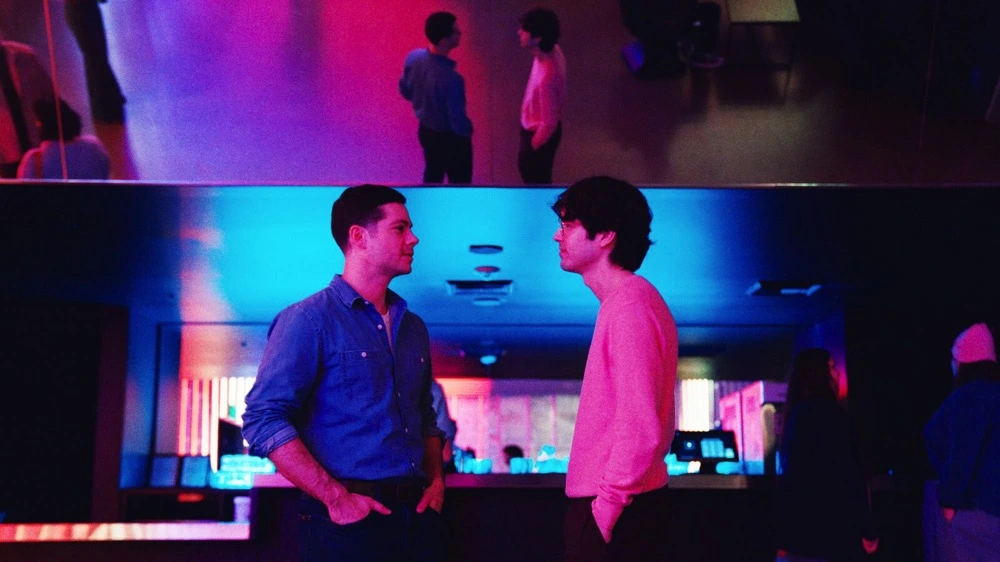
As a filmmaker, Sweeney proves both exacting and fearless. His script is acutely observant, particularly in its examination of queer loneliness and the uncomfortable, unflattering behaviours that can arise from it. This is not messiness for effect, but a clear-eyed reckoning with impulses many would prefer not to name. Dennis, especially, is drawn without sentimentality, a character who invites empathy while remaining deeply unsettling.
O’Brien, meanwhile, delivers the performance of his career. Tasked with inhabiting two versions of masculinity that could not be more opposed, he makes each feel fully realised. His portrayal of Rocky crackles with confidence and danger, while Roman’s awkwardness never drifts into caricature. The contrast is sharp, and the actor navigates it with impressive restraint. Opposite him, Irish actor Aisling Franciosi makes a vivid impression, bringing warmth and wit to a role that could easily have been sidelined.

What ultimately sets Twinless apart is its refusal to play safe. The film lurches between bleak humour, explicit intimacy and moments of genuine shock, but none of it feels engineered merely to provoke. There is a bruised humanity running through every scene, anchoring even the most extreme turns. For all its preoccupation with doubles and mirroring, this is a film that feels singular in voice and vision.
Unsettling, darkly funny and quietly devastating, Twinless announces James Sweeney as a filmmaker willing to risk alienation in pursuit of something honest. It’s a film that lingers long after the screen fades to black, difficult to categorise and even more challenging to forget.
Overall: 7.5/10

Movie Reviewer