Cast: Éanna Hardwicke, Steve Coogan, Alice Lowe, Jamie Beamish, Alex Murphy, Harriet Cains, Peter McDonald
Genre: Biography, Drama, History, Sport
Directors: Lisa Barros D’Sa and Glenn Leyburn
In Irish Cinemas: 26th December 2025
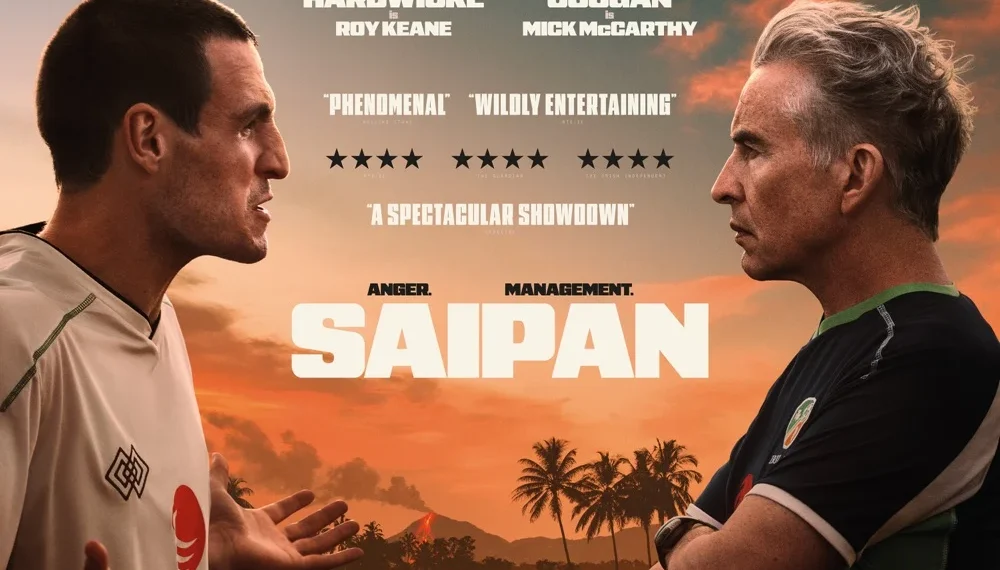
Even for audiences with no particular fondness for football, Saipan offers a gripping, fast-moving dramatisation of one of the most infamous implosions in Irish sporting history: the ferocious showdown between national team captain Roy Keane and manager Mick McCarthy in the fevered run-up to the 2002 World Cup. Directed by Lisa Barros D’Sa and Glenn Leyburn, the film is brisk, entertaining and sharply observed, anchored by two finely judged performances and buoyed by an evocative period soundtrack featuring Bob Dylan, The Pogues and The Walker Brothers, which adds emotional depth without tipping into nostalgia.
Those strengths should translate smoothly to audiences beyond Ireland. The latest feature from the husband-and-wife team behind Good Vibrations (2012) and Ordinary Love (2019), Saipan is a polished, accessible crowd-pleaser, already backed for UK and Irish release by Wildcard and Vertigo. Following high-profile screenings at the Toronto International Film Festival and the London Film Festival, it feels well positioned to resonate with viewers drawn as much to human drama as to sporting lore.
Roy Keane arrived at the 2002 World Cup carrying not just the captain’s armband, but the full burden of national expectation. A figure of near-mythic intensity, Eanna Hardwicke portrays him with flinty physicality and a coiled, barely contained fury. Lean and unsparing, Hardwicke captures Keane’s absolute devotion to standards, discipline and preparation. This is a man who understands precisely what it means to represent Ireland on the world stage, and he pointedly reminds teammates that even icons such as George Best were never afforded that privilege. When the squad decamps to a ramshackle training base on the Pacific island of Saipan, Keane’s fixation on professionalism stands in stark contrast to the holiday atmosphere embraced by those around him.
Steve Coogan’s Mick McCarthy is Keane’s ideological opposite. A former player turned manager, McCarthy is a pragmatist who believes in compromise, flexibility and morale over rigid adherence to principle, a worldview neatly summarised by his wife Fiona (Alice Lowe), who tells him, “Football is what you do, it’s not who you are.” Coogan plays McCarthy as fundamentally decent but irresolute, a man ill-equipped to impose authority on a player whose conviction and sense of purpose vastly exceed his own. His habitual hesitancy and apologetic tone only exacerbate the power imbalance, feeding Keane’s contempt.
Screenwriter Paul Fraser, whose earlier collaborations with Shane Meadows include TwentyFourSeven and A Room for Romeo Brass, deftly compresses and dramatises the events without sacrificing their broader cultural significance. The script is shot through with dry humour, particularly in its depiction of the Saipan camp’s astonishing dysfunction: a scrubby pitch better suited to grazing livestock, a training setup so amateurish that no one has thought to order footballs. As Keane repeatedly crashes into this chaos, his stubbornness begins to feel less petulant than principled, even, at times, heroic.
Fraser is equally attuned to the wounded pride and masculine intransigence that power the conflict, and to the way it spilt beyond the team to grip the Irish public. Barros D’Sa and Leyburn amplify this sense of national obsession through energetic montage sequences that blend TV footage, punditry, and vox-pop reactions, conveying a media circus in full roar. Jon Culshaw provides a wry extra touch by voicing Alex Ferguson, heard but never seen, the one managerial figure who might plausibly have met Keane on equal terms.
Formally, the film often frames Keane and McCarthy together using split screens. Yet, their most consequential encounters unfold in cramped, uncomfortable spaces, an aeroplane toilet, a hotel sauna where power struggles become intensely personal, and escape is impossible. Comfort, physical or emotional, is denied to both men. While McCarthy may appear more conciliatory, Saipan makes clear that pride and ego drive both of them.
By leaning into that tension, Saipan transcends its sporting origins. What emerges is a taut, intelligent study of authority, identity and the cost of uncompromising belief, a portrait of two men locked in a collision that was, perhaps, inevitable.
Overall: 7.5/10

Movie Reviewer