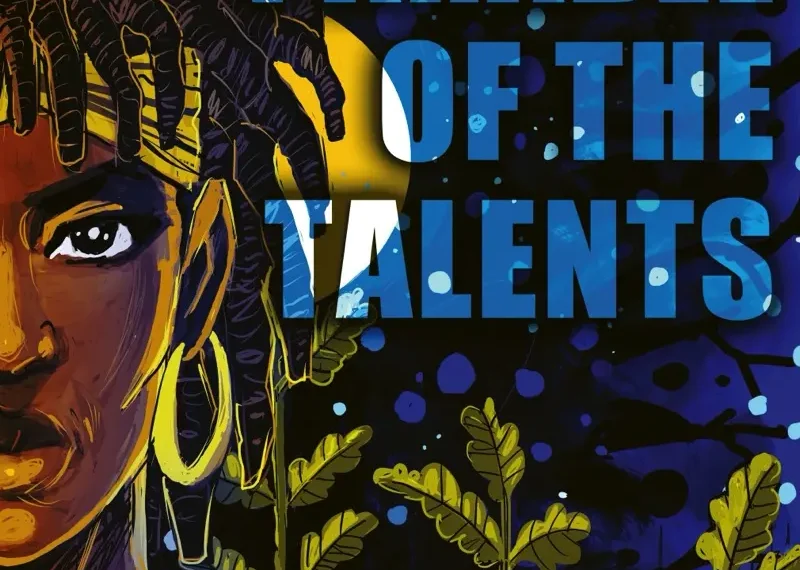
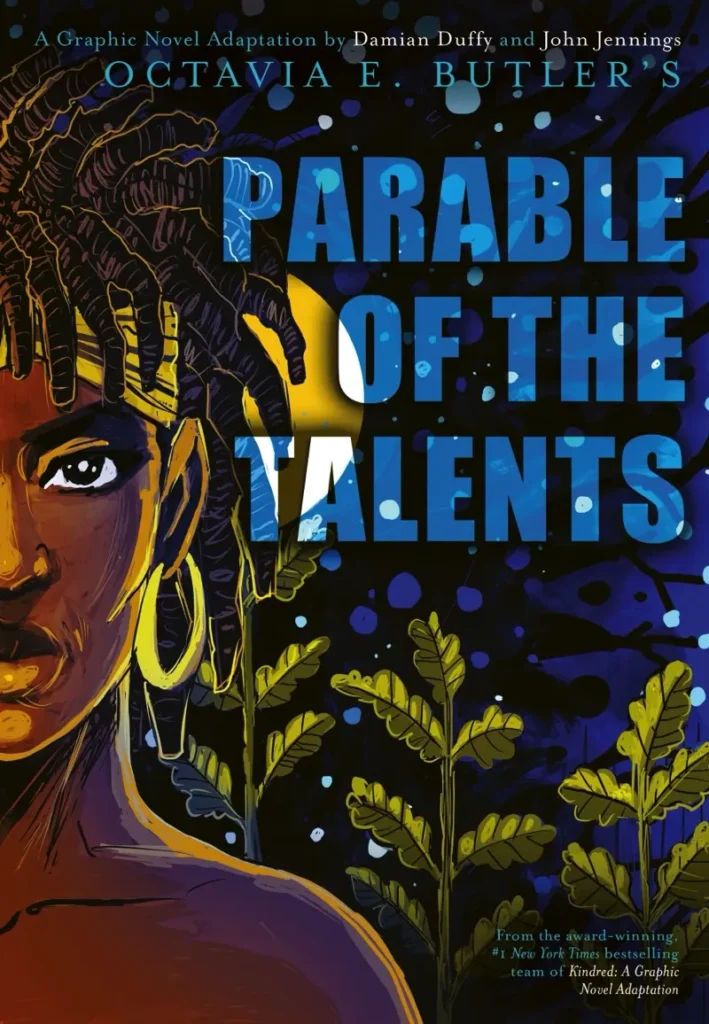
With the release of the graphic novel adaptation of Octavia E. Butler’s sci-fi novel The Parable of the Talents today from Abrams ComicArts, we are delighted to be joined by Hugo Award-Winners Damian Duffy and John Jennings.
Hi John and Damian, it’s so lovely having you both here with us.
Could you please introduce yourselves to our readers?
John: I am John Jennings. I am a Professor of Media and Cultural Studies at the University of California at Riverside.
Damian: Thanks for having us! My name’s Damian Duffy, I’m a cartoonist, writer, and letterer, with a MS and PhD in Library and Information Science, teaching at the University of Illinois School of Information Sciences when I’m not making, curating or studying comics.

Can you tell us what it was like adapting Parable of the Talents into a graphic novel?
John: I think this was easier in the fact that we’ve done this two other times. However, the physical and psychological aspects to Parable of the Talents cannot be denied. I think there is a level trauma at adapting these books that will most likely haunt us for a while.
Damian: In some ways, it was the easiest of the three adaptations of Octavia E. Butler novels John and I have done. Technically, I felt like I had a better sense of how to edit the original down to fit in the page space available without sacrificing important story moments, and I felt freer to experiment with page composition and point of view. (because Parable of the Talents has multiple narrators, whereas the previous book in the duology, Parable of the Sower, only has one).
In other ways, it was the most challenging, because Butler’s dystopian warning of a 21st century United States slouching towards fascism in the wake of widespread income inequality, crumbling institutions, and climate catastrophe has turned out to be so hauntingly prophetic

David Brame has joined you on this graphic novel; how did that come about?
Damian: The comics industry at large has correctly noticed that John is a superstar, so his attention has been pulled in multiple directions, all of which must be ignored when his young son is trying to jump from someplace that’s too high up. So he needed some help, both of us have worked with David over the past 10-15 years, so we were both well aware that David’s talent, speed, and professionalism was what we needed to get the graphic novel (the longest of our careers!) finished and out into the world.
John: As Damian stated, a lot of things have changed in our lives since the signing of the two-book contract to execute these books. One has to be flexible with projects this large and figure out the best ways to get the project done. 288 pages in full color is a heavy lift for one artist. This amount of work compounded with the inherent trauma of the subject matter made it necessary to expand our team.

How would you describe the Parable duology?
John: I think, unfortunately, that the duology is prescient and necessary in these troubled times. When people talk about dystopian fiction, often we see The Handmaid’s Tale, 1984 or A Brave New World touted as the best in the genre. I feel that the Parable duology is at the top of these lists though because of the meticulous nature of Butler’s research. We are in the middle of her stories and it’s a testimony to her dedication to the craft but also the hope that we listen and can change.
Damian: To paraphrase the great author Tananarive Due, who was kind enough to be a consultant on both adaptations, Octavia E. Butler uses the Parables to break you, then make you stronger in the broken places. Writ large, it’s a dire warning built on well-researched facts about the assault on a functioning civil society by the fascistic ravages of late capitalism dismantling representational democracy. But, that’s just the setting, increasingly familiar though it may be. In that world, we witness the life and legend of Lauren Oya Olamina unfold.
In Sower, she’s a teenager struggling through apocalyptic home invasions, wildfires, and the dangers of her hyperempathy syndrome, a neurochemical disorder that makes her feel the things she sees other people feeling.
In Talents, we find Lauren in her twenties, struggling to lead a hardscrabble rural community, while preaching a religion that says “God is Change,” and human destiny is interstellar travel. Meanwhile, an apocalypse only exacerbates family drama, and Lauren’s life as a wife, sister, and mother, like all her ambitions, is constantly under attack. But in the future, we’re told, Lauren’s followers will make her a god. Parable of the Talents shows how she gets there.

Parable of the Talents is the third graphic novel, adaptation from author Octavia E. Butler, which you have worked on. Do you feel you know her better now as an author, and what do you think about her as an author?
John: I think that I understand the themes that she deals with on an intimate level and I feel that I have discovered a rhythm and methodology for visualizing her worlds.
I think that Butler was a genius and was a master at the craft of writing. Her characters have nuance and depth that only someone who has wrestled with themselves can create. I really respect her work and I’m so honored to help magnify her novels.
Damian: After reading Parable of the Talents, Parable of the Sower, and Kindred like 14 times each, I can safely say I know Butler better as an author. When I first read Kindred, at age 19, I thought Butler was a genius. Now, I know better: “genius” is too glib a term for her greatness. Her research was peerless, her thinking intricate, layered, nuanced, important. Her sheer commitment to the craft of writing, to always improving that craft, stays daunting compared to even the most seasoned professional.
There’s this moment in Scott McCloud’s book Understanding Comics, where he talks about how, in manga, something like a sword can be drawn very simplistically when viewed from far away, but a close up of that same sword will be extremely detailed and hyperrealistic. Butler’s writing is kind of like that. You can read it as terse, straightforward. But, look closer, and you see what seemed straightforward has been built on the most intricate, complex foundation, and is all the more impressive because of it.

What can comic fans expect from Parable of the Talents graphic novel?
John: I think you can expect some fresh designs on the page and some interesting play with our palette. We can thank Alexandria Batchelor, our color production lead, for that! It’s a harrowing journey that I am immensely proud of.
Damian: The comics version of 1990s dystopian Afrofuturist science fiction about real life right now that puts your heart in your throat, then back down in your chest, just before it’s broken, then healed, stronger for the experience. Also, I lettered some sound effects I was kinda proud of. This one bullet ricochet sound effect, I thought was pretty good.
Any message for the ComicBuzz readers?
John: Exercise a radical level of empathy whenever possible. We need each other in times like these. Make art. Support the future. Protect our histories.
Damian: Support your local comic shops, independent bookstores, and public libraries like your life depends on it. Because, yeah, technically, your life doesn’t depend on it, but things that make life worth living certainly do.
We would like to say a big thank you to Damian and John for chatting with us, and we would like to wish them the best of luck with the release of The Parable of the Talents graphic novel.